

Academic Sharing丨 “Silk Road Archaeology and Heritage Forum” Lecture 4: “The Current Status of Research on the Okunev Culture”
On the evening of October 23, 2023, the 4th lecture of “Silk Road Archaeology and Heritage Lecture Theatre” of Silk Road Archaeology Cooperative Research Center was successfully held in the conference room 910 of the School of Cultural Heritage of Northwestern University, which was titled as “The Current Situation of the Research on Okunev Culture”, and was given by researcher Andrey Vladimirovich Poliakov, director of the Institute of the History of Physical Culture, Russian Academy of Sciences, who gave a lecture. --The lecture, titled “Current Status of Research on Okunev Culture”, was given by researcher Andrey Vladimirovich Poliakov, Director of the Institute of History of Material Culture of the Russian Academy of Sciences, and moderated by Prof. Shao Huiqiu of Silk Road Archaeology Cooperative Research Center.
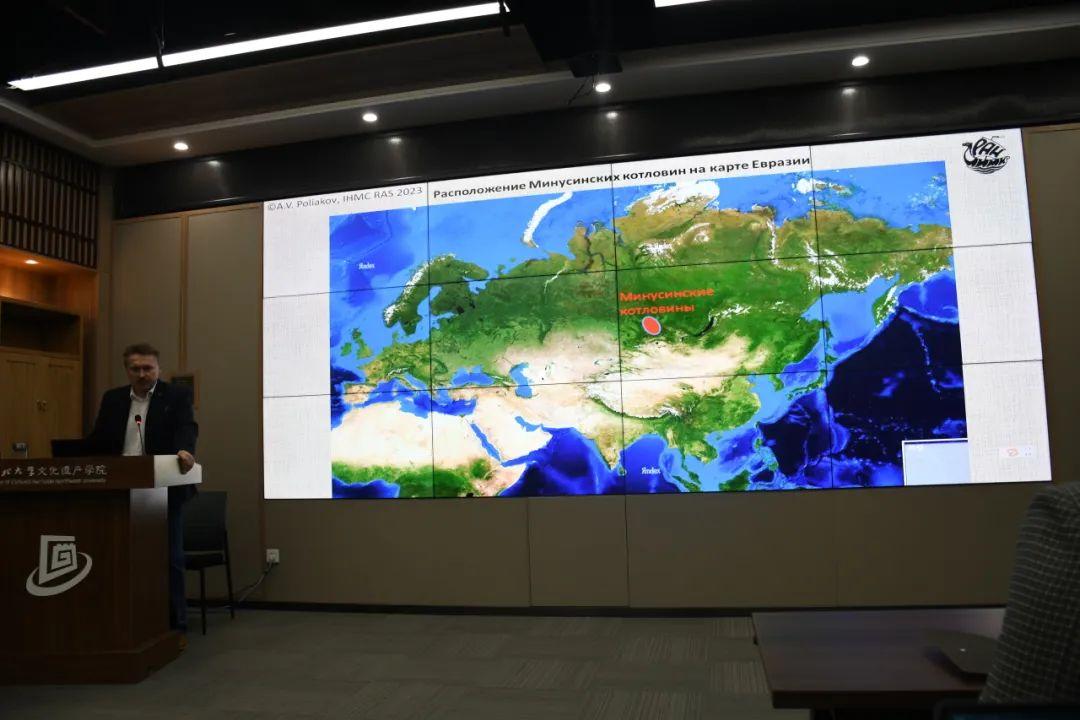
At the beginning of the lecture, Mr. Palekov gave a brief introduction to the geographic location of the Minusinsk Basin, where the Okunev culture is located, its natural environment and its history of research, and described the established archaeological cultural sequence in the Minusinsk Basin, in which the Okunev culture is dated to the 26th to the 18th centuries BC, and the Okunev culture was preceded by the Avanashevo culture. The main cultural features of the Okunev culture are secondary burials and a tradition of cranial deformation with a pronounced collapse of the postcranium.
Current scholarship generally divides the Okunev culture into three phases based on burial features, and Mr. Palekov systematically describes each phase of the Okunev culture in the following section.
I. Early Okunev culture: Uibat stage
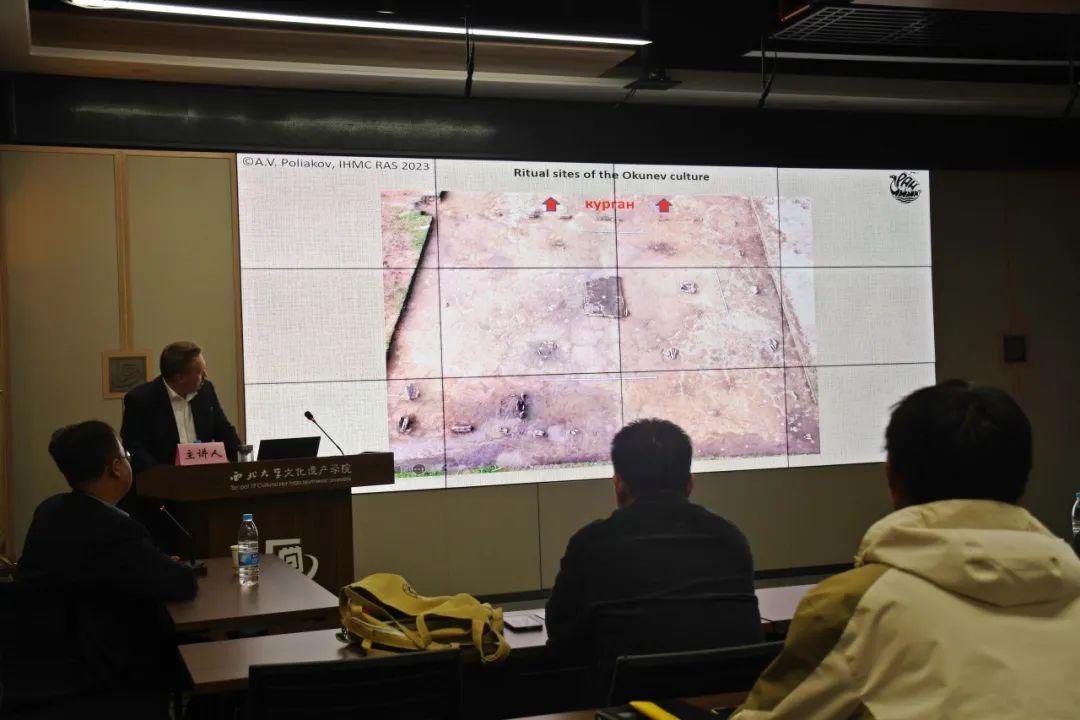
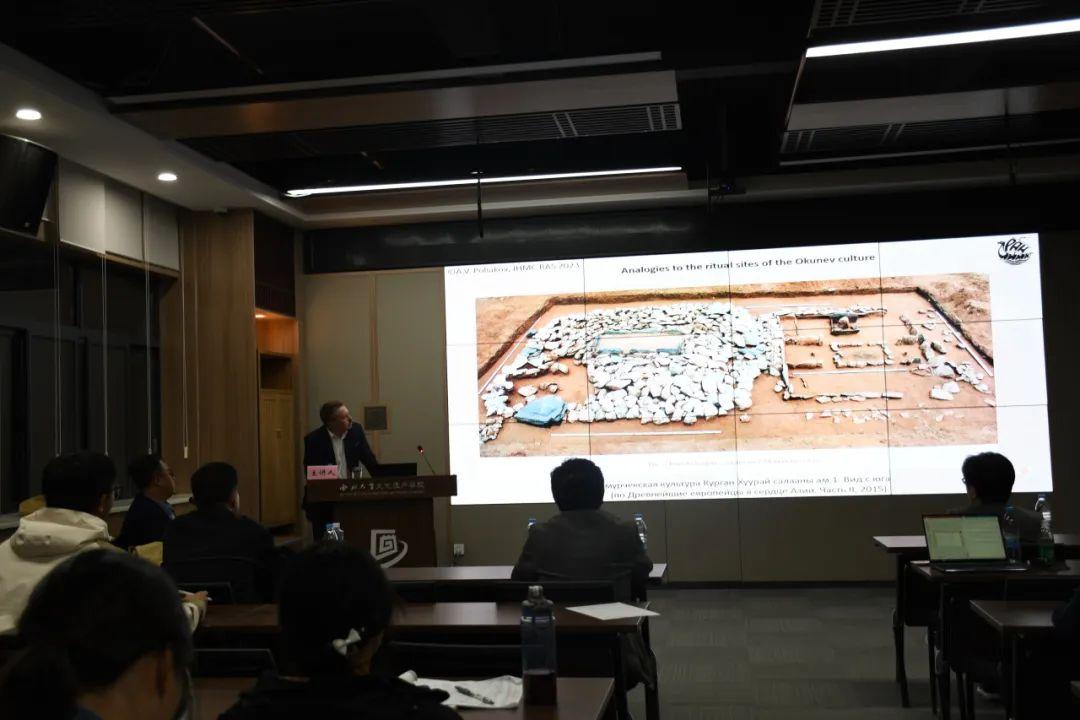
The absolute date of the early Okunev culture is the 26th-23rd centuries BC. In this period, the square burial enclosure was made of large stones, the center of which was filled with stones and topped with a mound of earth, known as a “kurgan” (burial mound), and there were also cases when burials of a later date broke the sealing soil within the enclosure and continued to be buried. The distribution of subsidiary graves around the central grave occurs in the later stages of the Uyghur Patriarchal Period, with the peripheral graves arranged in a chain around the center. The female burials were mainly sideways and bent-legged, while some of the male burials were mainly tilted. There are also cave tombs and barrow tombs.
Typical pottery of the Uygurat period is flat-bottomed jars, with more incised and punctured patterns on the surface of the vessels, and some of them have painted “Y” patterns, and nearly half of the flat-bottomed jars of the period are decorated with a raised pearl pattern on the neckline. This period of pottery is also used for special rituals, the internal existence of the partition of the smoker, often in its surface is decorated with a more divine decorative images, such as the sun-shaped, human face, and so on. Copper can be seen dagger, sword, cone, needle and other types of vessels, copper dagger and copper sword there are morphological differences, cone and needle generally out of the bone tube, mostly found in female burials, there are also copper syringes.
In the late Uygbat period, animal teeth used by the local Neolithic population began to appear in burials, indicating that communication with the local population began at this time. This phenomenon is also supported by physical anthropology and ancient DNA evidence. Perforated marble balls were also seen, mostly in the burials of male minors.
Artistically, smokers and bone combs are decorated with images of faces typical of the Okunev culture, as well as elaborate hollowed-out sculptures of snake heads. It is noteworthy that some bone sculptures of unique shape and complex elements with mythological colors were found on the chests of male infant graves of the Uygbat period.
II. Middle Okunev culture: Chernovaya stage (Chernovaya stage)
The absolute date of the middle stage of the Okunev culture is the 22nd-20th centuries BC. In this period, square graves were surrounded by stone slabs, and there were no central graves in the “Kurgan”; instead, there were rows of graves, and the surrounding graves were still arranged in a chain. Most of the tombs are sarcophagus tombs, in which the four walls and the bottom of the sarcophagus are made of stone slabs, and the burial style of the tomb owner is mostly tilted up with the body flexed, the head high and the foot bottom, and the tomb is in the form of slope, and there is no burial in the form of cave tombs in the previous period.
Chernovaya period pottery is mostly hexagonal footed vessels with hexagonal mouths, and the grate-toothed embossing pattern on the surface of the vessels is only found in this period, and there is a parallel scratching pattern that is different from the pearl pattern of the previous period, and there are typical fishing and hunting tools, such as fishhooks and pikes, which are not found in the previous period. Perhaps it is because the Okunev culture was mainly composed of the steppe people in the early period, but after arriving at the area, it started to have exchanges with the local indigenous people, and joined in the fishing and hunting oriented production activities.
The burials also included a needle quiver, an arrow shaft straightener, a leaf-shaped copper knife, and beaded decorations. The stone balls that accompanied the burials of minor males in the previous phase disappeared. Two types of small, realistic bone sculptures appear in this phase, the first of which shows only the head; the other, with long hair and earrings, appears to be a female figure. Chernovaya period of plastic art is also rich, more on behalf of the land beasts of the complete animal image, at the same time has a strong mythological color; also see a typical three-eyed sphinx image.
III. Late Okunev Culture: Razliv Stage (Razliv stage)
The absolute date of the Late Okunev Culture is the 19th to 18th centuries BC. In this period, square burial enclosures were made of stone slabs planted vertically, ritual areas appeared in the “kurgan”, and the middle part of the buried bison skulls was coated with red ochre. There are various types of burials of tomb owners, and fewer burial objects have been unearthed, mainly pottery, stone tools, bone tools, and jade tools.
Pottery was only found in the minor burials a few small non-utilitarian ware, or children's toys; stoneware can be seen in large size scepter head (or weapons); boneware can be seen in the fish dart, under the tongue bone; jade jade jade jade ring (or broken jade ring). At this stage, the tradition of thick burials was no longer followed.
The human figurines of the Razlif period, which appear to have shoulders, also appear to have male figures with more specialized hairstyles. There are also bone sculptures that resemble the head of a horse, and it is assumed that the people of the late Okunev culture began to use horses. The plastic arts of the Lazhliv period are clearly a continuation of the previous period, with abstract combinations of human faces rich in mythological colors. In addition, craniectomy was popular among the population of this period, and it is believed that it was performed after death with the use of curved tools.
Finally, Mr. Palekov highlighted the rich and varied stylistic and graphic art of the Okunev culture, which, in addition to sun shapes, human face motifs and three-eyed sphinxes, also had a large number of animal figures. The plumpness and fatness of the animals in the early period, and their thinness and slimness in the later period, seem to indicate environmental changes in the region, the degradation of pastures, and the reduction of subsistence resources. Although some of the stylized and graphic art was destroyed during secondary burials, scholars have identified more than 1,000 types that express the colorful and creative spirituality of the people of the Okunev culture. Teachers and students on the spot interacted with Mr. Palekov on issues such as the materials of Okunev culture itself and the relationship with Chinese culture in a lively atmosphere. The moderator, Prof. Shao Huiqiu, summarized the content of the lecture and expressed his sincere gratitude to Mr. Palekov.