

Academic Sharing丨Silk Road Archaeology and Heritage Lecture No. 3: “Archaeological Research and Conclusions on the Site of Uchitepe, Naryn District, Najugan Oblast” (Chinese only)

On the afternoon of October 22, 2023, the 3rd lecture of “Silk Road Archaeology and Heritage Lecture” of Silk Road Archaeology Cooperative Research Center was successfully held in Room 910 of the School of Cultural Heritage of Northwestern University. The lecture, titled “Archaeological Research and Conclusion of Uchitepe Site, Naryn District, Najugan Oblast”, was given by Prof. Ahmadali Askarov, member of the Academy of Sciences of the Republic of Uzbekistan and a famous archaeologist, and moderated by Prof. Wang Jianxin, Chief Scientist of the Center for Cooperative Archaeological Research on the Silk Road.
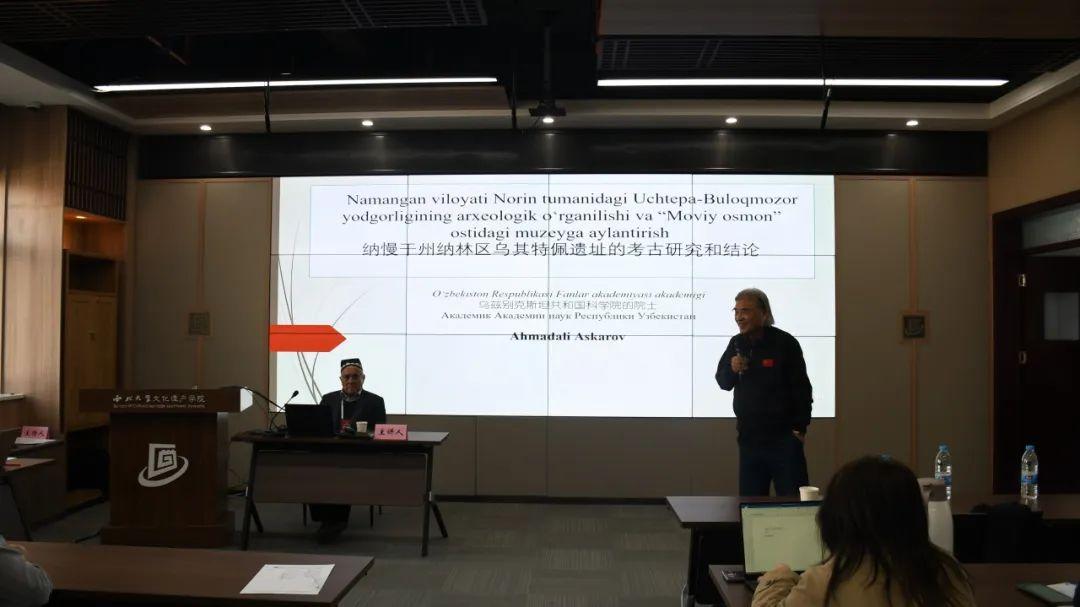
Academician Askarov began his lecture by describing his feelings about visiting sites and museums in China, expressing his affirmation of Chinese archaeological and cultural relics protection work, and mentioning that a large number of Central Asian style relics have been found in the Xinjiang region of China, and that China and Central Asia had already established close economic and cultural ties as early as the Bronze Age, and that it was not until the Early Iron Age that Central Asia started to It was not until the Early Iron Age that Central Asia began to establish ties with the Shaanxi region of China, and with the opening of the Silk Road during the Han Dynasty, ties between the two regions became more widespread.
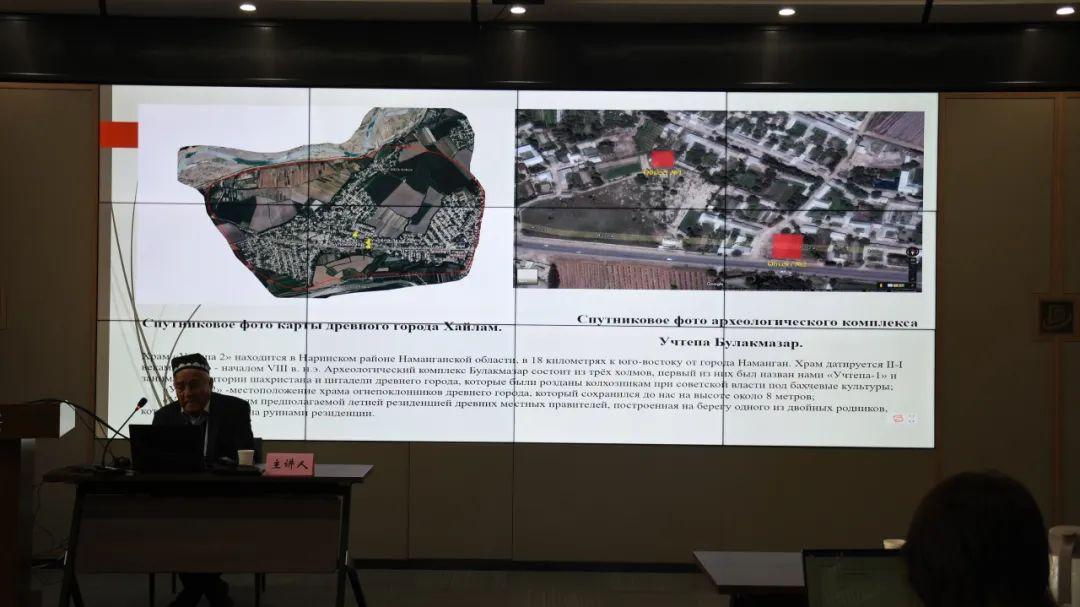
Temporal and spatial location of the Uchtepa site. The site complex consists of three hills, Uchtepa 1, which was developed as a farm during the Soviet period and was therefore severely damaged, and Uchtepa 2, which is the site of an ancient Zoroastrian temple, located in the Norin district of the Namangan region, 18 kilometers southeast of the city of Namangan, and dating from the 2nd-1st centuries B.C.E. to the beginning of the 8th century A.D. The surviving height is about 8 meters. The surviving height is about 8 meters; the site of Uchitepe 3 was an ancient summer residence of local rulers.
In July 2018, the High-Tech Laboratory of the Ministry of Innovation and Development of Uzbekistan conducted the first ground scanning and surveying at the Uchitepe 2 and 3 sites using an optical-magnetic scanner, which showed density anomalies at a depth of 1.5 and 7 meters at the Uchitepe 2 site. Combined with the scanning results, Academician Askarov led the archaeological team to carry out test excavations on the northwest side of the hill to understand the stratigraphic profile overview in order to guide the later excavation work. As a result of the excavation, the central part of the temple was built on an earthen platform at least 1.5 meters high. In the center of the temple was the hall, surrounded by four quadrilateral altars in the north, east, south and west. The total area of the temple was 540 square meters.
After studying the plan of the temple's early medieval architecture, Academician Askarov focused his archaeological excavations on the early cultural layers: the temple walls were found at a depth of 2.3 meters from the surface; the altar floor was found at a depth of 3.3 meters from the surface. The finds belong to two chronological phases: the early pottery with a slightly reddish surface dates from the 2nd-1st centuries B.C. to the beginning of the A.D.; and the pottery shards with a dark reddish glaze found in the late stratum date from the 3rd-4th centuries A.D. The pottery sherds were also found in the late stratum, with a dark reddish glaze. In addition, the central pillar of the temple was found at a depth of 1.2 meters from the surface, under which were superimposed the remains of an oval stone altar structure.
The burials at the site were all very simple, and only one piece of burnt pottery, an iron knife and iron belt buckle were found with the burial goods, which were in a poor state of preservation. In the same stratum, three complete ceramic vessels were found, which were probably used during the religious ceremonies around the main altar No. 6. Early medieval vessels for warming water or milk were also found at the site.
A large number of artifacts related to fire worship and stone worship were found during the excavation of the temple. These included more than 50 hearth altars used for fire worship and more than 20 stone altars. While the characteristic element of temples in Early Antiquity (2nd-1st centuries B.C. to 2nd century A.D.) was an altar with visible traces of the use of fire, by Late Antiquity (3rd century A.D. to 4th century A.D.), in addition to fire-worshipping altars, stone altars appeared, and by the Early Middle Ages, stone altars had spread to a wider area. This evolution indicates the gradual replacement of the fire cult by the stone cult, i.e. the influence of Buddhism on the spiritual world of the Fergana population in the early Middle Ages.
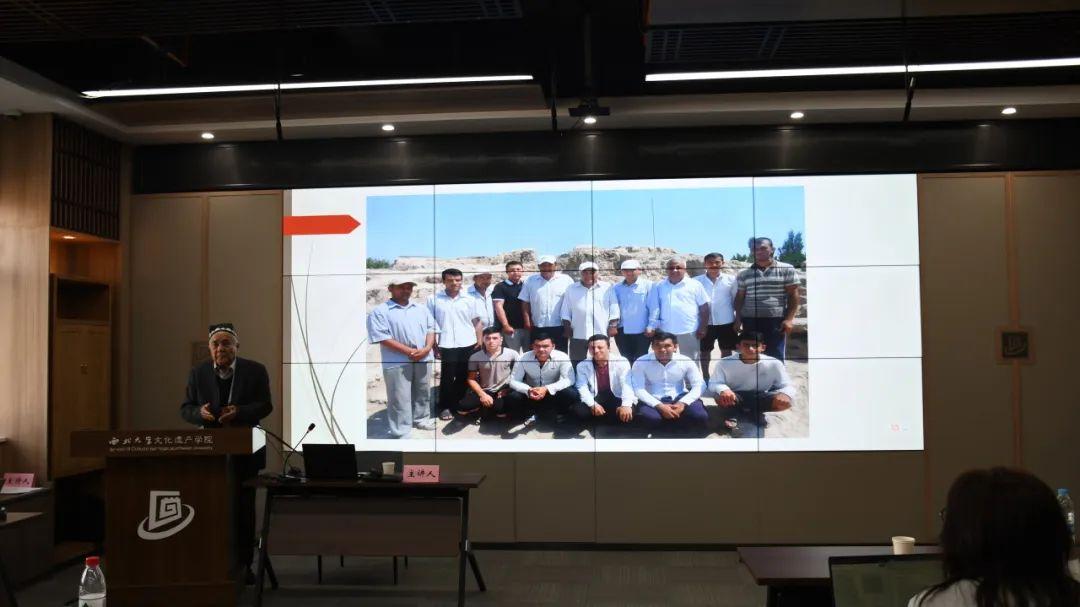
Finally, Academician Askarov expressed his eager expectation for the establishment of the Uchitepe Site Museum, and put forward corresponding measures to solve the problems existing in the establishment of the museum, as well as his concern about the current situation of the site protection. Prof. Wang Jianxin pointed out in the final conclusion that the protection and display of earth sites is a worldwide problem faced by many countries, and while China is constantly conducting archaeological excavations, it is also constantly facing new problems, the solution of which is pending more academic discussions, and Prof. Wang Jianxin expressed his sincere thanks to Academician Askarov.