

Academic Sharing丨Silk Road Archaeology and Heritage Lecture No. 5: “On the Bronze Age and Bronze Age in China: From New Archaeological Discoveries in Xinjiang” (《Silk Road Archaeology and Heritage Lecture")

On the afternoon of November 18, 2023, the 322nd lecture of “Houwailu Academic Lecture”, the 205th Bowang Forum of the School of Cultural Heritage, and the 5th lecture of “Silk Road Archaeology and Heritage Lecture” of the Silk Road Archaeology Cooperative Research Center were successfully held in the 910 conference room of the School of Cultural Heritage of Northwest University. The 5th lecture of “Silk Road Archaeology and Heritage Forum” was successfully held in Room 910 of the School of Cultural Heritage of Northwest University. Prof. Han Jianye from the School of History of Renmin University of China was invited to give a lecture on “About the Copper and Stone Age and Bronze Age in China - Starting from the New Archaeological Discoveries in Xinjiang”, which was presided over by Prof. Shao Huiqiu of the Center, and nearly one hundred representatives of teachers and students from both inside and outside the university listened to the lecture.
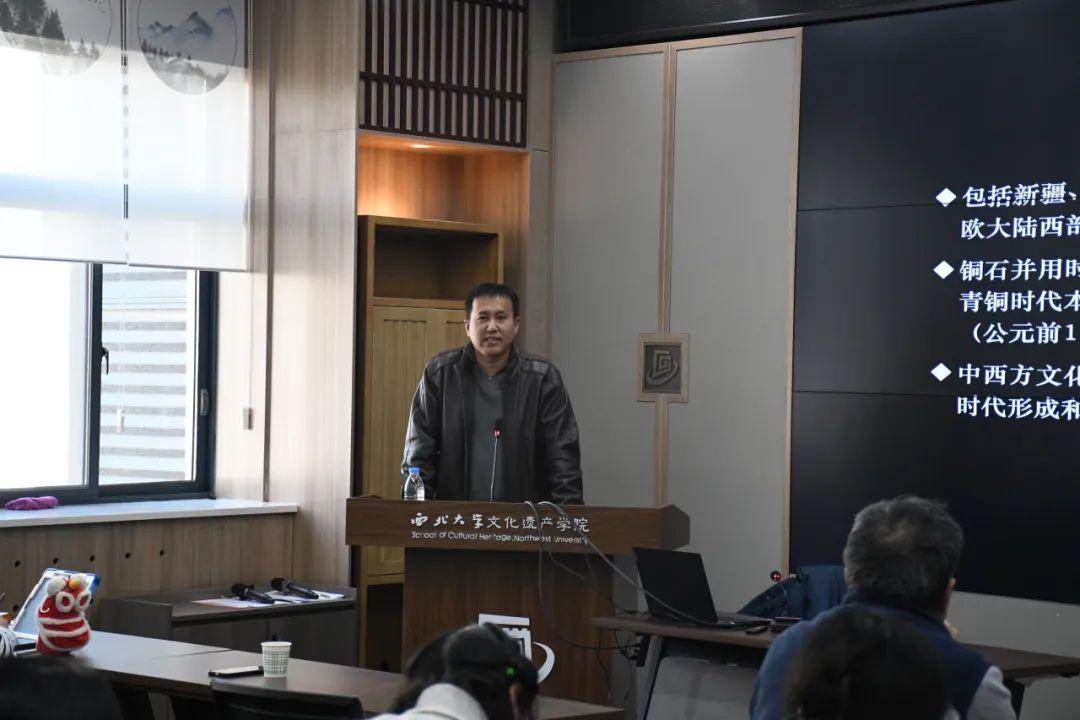
Prof. Shao Huiqiu of the Silk Road Archaeology Cooperative Research Center presided over the meeting.
At the beginning of the lecture, Prof. Han Jianye briefly explained the concepts of the Copper and Stone Age and the Bronze Age and the status of research, and suggested that the Xinjiang region is the key to the study of the Copper and Stone Age and the Bronze Age in China, and that the Xinjiang region has to be included in the scope of research when thinking about the archaeology of China.
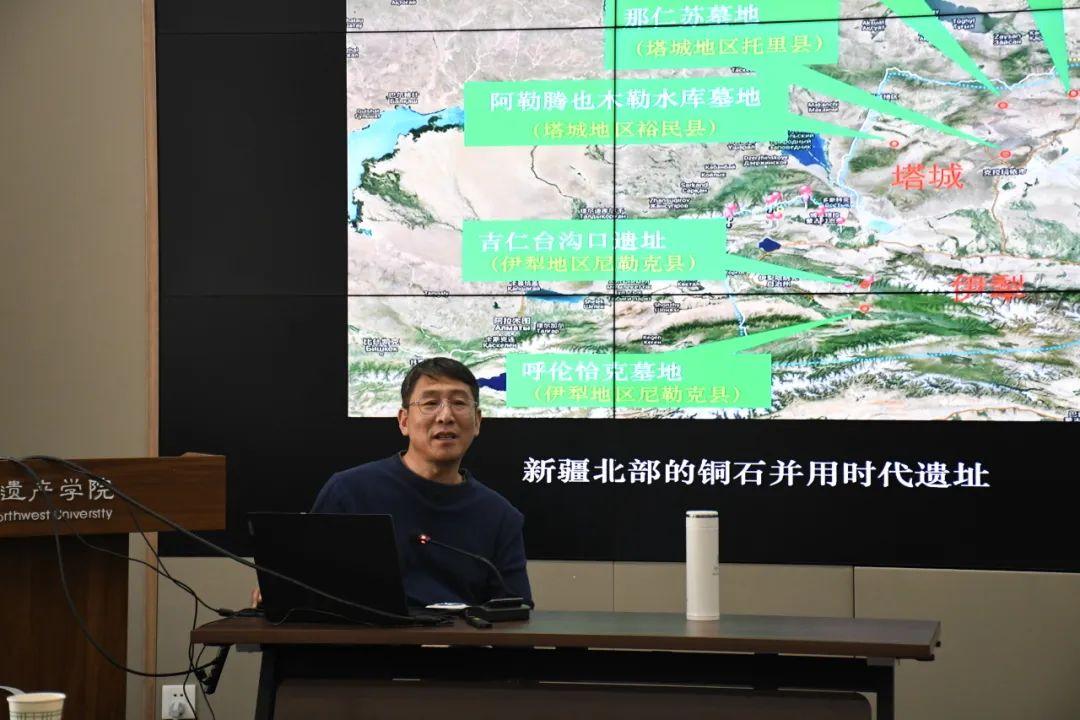
Lecture by Prof. Han Jianye
Starting from the analysis of new archaeological discoveries in Xinjiang, Prof. Han Jianye discussed the chronological range and basic features of the Copper and Bronze Ages in China from four aspects, taking into account new archaeological data from other regions.
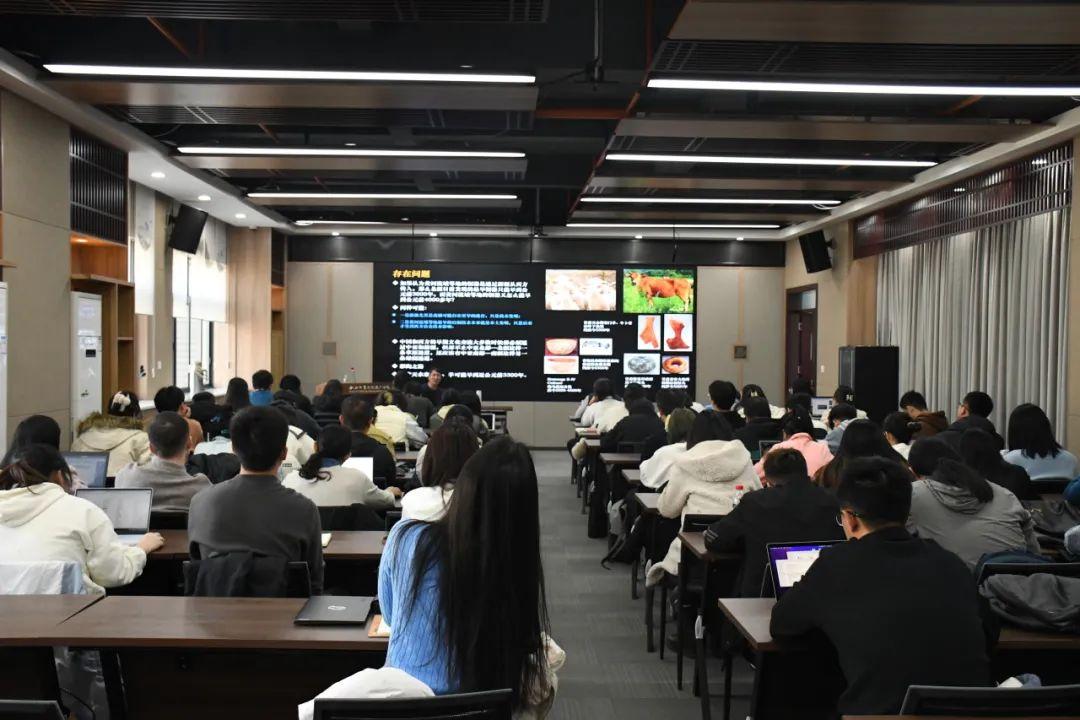
Lecture site
Aspects of the Copper and Stone Age in Xinjiang. In Altay, Tacheng and Yili regions in the north and west of Xinjiang, a number of sites dated between 3000 and 2500 BC have been found, such as the Tongtian Cave site, Aytohan No. 1 Cemetery, Pine Gully Cemetery, Huojirgou Cemetery, and Jirentai Goukou site. Prof. Han Jianye pointed out that the remains of this type should belong to the Avanashevo culture system in general, such as its basic features as round stone-enclosed tombs, tilted body and bent limbs burials, hematite powder sprinkled on the bottom of the tombs, and the popularity of pottery with a pointed rounded base, with a large number of red copper wares, and so on. However, the cave tombs also reflect the characteristics of Xinjiang itself, or can be called the Aitokhan culture. Prof. Han Jianye thinks that it is appropriate to classify the Avanashevo culture into the Copper and Stone Age in general, and it should belong to the late Copper and Stone Age or have the nature of the transition stage from the Copper and Stone Age to the Bronze Age. The absolute age of Xinjiang's Aitokhan culture is similar to that of the Afanashevo culture, considering that most of the bronzes found in this culture are red copper or arsenic-like bronze containing a certain amount of arsenic, so they should also be categorized into the nature of this era. The source of the Avanashevo culture is believed to be in the western part of the Asian-European steppe, that is, the Eastern European steppe region, and the Aytokhan culture is no exception.
Aspects of the Bronze Age in Xinjiang. Cultural remains in Xinjiang between 2500 and 1000 BC include the Chemurchek Culture, the Adunjolu Culture, and the Jirentai Goukou Culture in the northern Xinjiang region, the Tien Shan Beilu Culture in the eastern Xinjiang region, and the Tomb Gully-Small River Culture in the Lop Nor region.
The Chemulchek Culture, of which only burial remains have been found, is most similar to the Okunev Culture of the middle reaches of the Yenisei River in Russia, such as square stone-encircled slab tombs, sarcophagus burials, stone men in trees outside of the tombs, and popular huanji ware, etc. The absolute age of the culture is about 1,000 BC. Its absolute age is about 2500-1400 BC, and the lower limit of the age is already as late as the period of Andronovo culture, when it belongs to the early and middle Bronze Age.
The Adunjolu culture is represented by the main remains of the Adunjolu site in Hot Spring County, the Husta site, and the Jirentai Goukou site in Nilek County, which are distributed in the central and western parts of Northern Xinjiang. The absolute age of about 1800 ~ 1400 BC, belongs to the Andronovo culture system, popular bent limb burial, drum shoulder pots, the emergence of quite distinctive large stone enclosure settlements and large stone wall base houses, copper developed, are tin bronze. When the Adunjolu culture was in the middle of the Bronze Age, the square high-topped tombs found at the Jirentai Goukou site showed that its social complexity had reached a considerable degree, and it should have reached the stage of the so-called high-level “chieftainship”.
The Tianshan Beilu Culture, represented by the Tianshan Beilu Cemetery in Hami City, has an absolute age of about 2,000 to 1,300 B.C., which is roughly the same as that of the Adunjolu Culture, and the main body of the culture belongs to the middle Bronze Age.
The Jirentai Goukou Culture is represented by the 2nd and 3rd phases of the Jirentai Goukou Site, with smaller houses and popular huanji pottery, with an absolute date of about 1400 to 1000 B.C.E., roughly comparable to that of the Karasuk Culture, and belonging to the Late Bronze Age stage.
After about 1000 B.C., iron tools gradually increased in Xinjiang, and culture and society underwent great changes, entering the Early Iron Age.
Aspects of the Copper and Stone Age in the Yellow River Basin and Other Places. Professor Han Jianye combed through the copper-related remains found in the middle and upper reaches of the Yellow River and the West Liaohe River Basin, and concluded that the copper smelting and casting technology developed significantly and the number of copper objects increased around 3000 B.C.E., and that the Bronze and Stone Ages had already entered into the Bronze Age, which was a critical period for ancient cultures to move towards civilization. During this period, West Asia and other places entered the civilized society as China did, but archaeologically, they had already crossed into the Bronze Age.
In response to this phenomenon, Prof. Han Jianye raised the question of how the earliest bronze remains in Xinjiang appeared around 3000 B.C., while the earliest in the Yellow River basin appeared around 4000 B.C., to support the idea that bronze metallurgy was introduced to the Central Plains from the west to the east through the Xinjiang region. Prof. Han Jianye speculates that there are two possibilities: one is that there may be earlier remains in Xinjiang, especially in the southern part of the country, but they have not yet been discovered; the other is that the earliest bronze metallurgy in the Yellow River Basin and other places may have been a local invention, and it was only later on that they were influenced by Western metallurgical technology.
Aspects of the Bronze Age in the Yellow River and Yangtze River Basins. In the Longshan period between 2500 and 1800 BC, two major technological systems of Chinese bronze casting were formed. The first one was the technical system of casting bronze objects such as tools, weapons and ornaments in diabase models, which was distributed in the vast area of northwestern China, and it was likewise a common bronze casting technical tradition in the steppes of Asia and Europe, and the bronze objects cast under this technical system were mostly red copper, followed by arsenic bronze, and there was also tin-bronze; the second one was the technical system of casting bronze containers in composite clay models, which belonged to an invention of the Central Plains, and the bronze and its smelting and casting technology at This stage has spread to the lower reaches of the Yellow River and the middle reaches of the Yangtze River.
Prof. Han Jianye pointed out that copper wares and casting remains were commonly found from the Hexi Corridor to the Yellow River and the Yangtze River during the Longshan period, and red copper and bronze were common, which is similar to the situation of the Chemurchek culture and even the Okunev culture in the middle reaches of the Yenisei River in Xinjiang during the same period. From the discovery of bronze and related remains and the social changes, it is clear that China entered the Early Bronze Age after 2500 BC.
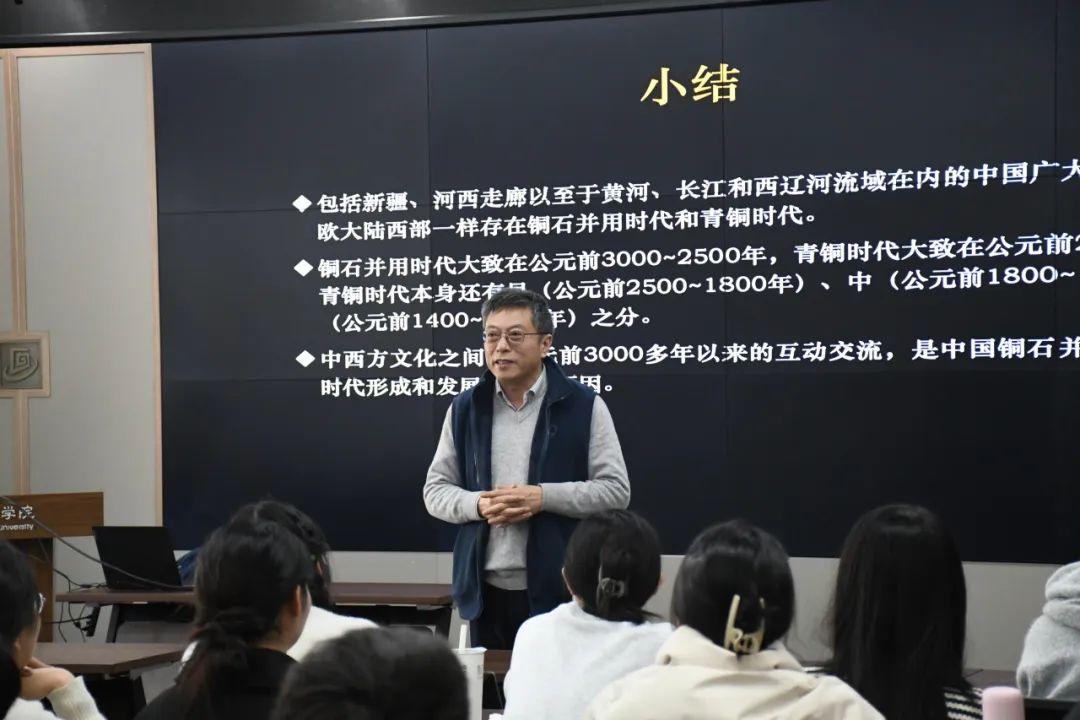
Exchange Session
Finally, Prof. Han Jianye argued that the Copper and Bronze Ages existed in a wide area of China, including Xinjiang, the Hexi Corridor, and the Yellow, Yangtze and Xiliao River Basins, just as they did in the western part of the Asian and European continents. The interaction between Chinese and Western cultures since 3000 B.C. is an important reason for the formation and development of the Copper Age and Bronze Age in China.
Teachers and students interacted and exchanged views with Prof. Han Jianye on the early Bronze Age in a lively atmosphere. The moderator, Prof. Shao Huiqiu, summarized the content of the lecture and expressed his sincere thanks to Prof. Han Jianye.