

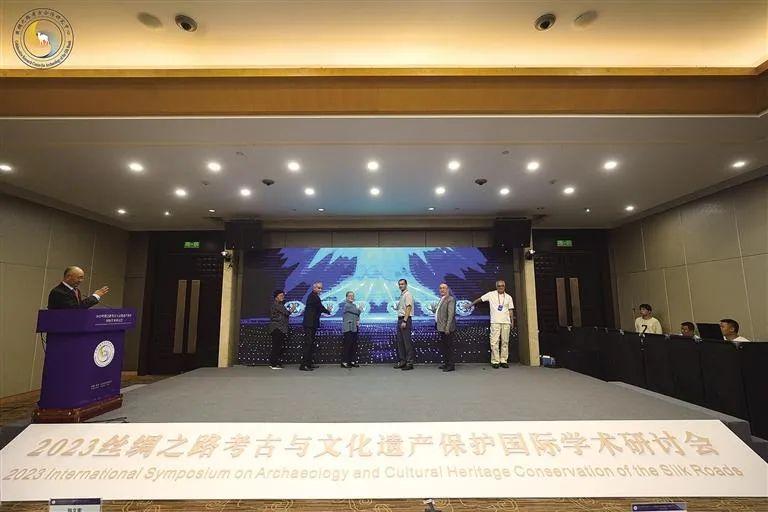
The First Plenary Session of the First Academic Committee of the Silk Road Archaeology Cooperative Research Center and the 2023 International Symposium on Silk Road Archaeology and Cultural Heritage Protection were held
Silk Road connects the world, culture communicates the future.
Under the guidance of China Heritage Fund, Shaanxi Provincial Cultural Relics Bureau, Foreign Affairs Office of Shaanxi Provincial People's Government, and Shaanxi Provincial Department of Education, the First Plenary Session of the First Academic Committee of the Silk Road Archaeology Cooperative Research Center and the 2023 International Symposium on the Archaeology and Cultural Heritage Protection of the Silk Road, which was hosted by Northwestern University, was recently held in Xi'an.
More than 100 experts and scholars from Kazakhstan, Mongolia, Nepal, Turkmenistan, Uzbekistan, Iran, the United Kingdom, Italy, Serbia and China's relevant universities and research institutions gathered at the starting point of the Silk Road to promote humanistic exchanges.
Sharing Dialogue Forming a Good Exchange Mechanism
More than 2,100 years ago, Zhang Qian set off from Chang'an, accompanied by the sound of camel bells, opened up the Silk Road that traversed the East and West, connecting Europe and Asia, and opened a new window for Chang'an's foreign exchanges. Now, on the 10th anniversary of the “Belt and Road” initiative, Xi'an has once again become a crossroads for cultural exchanges.
The symposium is a gathering of famous scholars from many countries to share their academic views at the conference.
Prof. Dashtsevig Tumen from the National University of Mongolia introduced the Bronze Age cultural sequence of Mongolia and listed the characteristics of each archaeological culture. Tumen said, “The study of ancient cultures and nomadic peoples is an important part of the history of civilization and history, with a long history of interaction between peoples. The Silk Road Archaeology Cooperative Research Center provides a new platform and new opportunities for scholars from various countries to conduct cooperative research, laying the foundation for future cooperation in Silk Road research.”
Prof. Masharekov Serdar, a researcher at the Institute of History and Archaeology of the Turkmenistan Academy of Sciences, introduced the phasing of the Anno and Namazga cultures and compared the phasing of the two. Serdar said, “In the future, I look forward to working with my Chinese counterparts to expand the space for cooperation in the field of archaeology.”
Taking the archaeological atlas of the Samarkand Basin in Uzbekistan as an example, Professor Saidov Muminhon of the Samarkand Institute of Archaeology of Uzbekistan showed the participants the attempts made by the archaeological institutions of Uzbekistan in the protection of sites, information management, etc., and pointed out the problems found in the process of compiling the archaeological atlas, and put forward targeted suggestions for improvement, such as electronic and systematization, which provided useful references for the follow-up of the joint archaeological work on the Silk Road. It also pointed out the problems found in the process of compiling the archaeological atlas and put forward targeted improvement suggestions such as electronicization and systematization, providing useful reference for the subsequent joint archaeological work along the Silk Road.
Exchange and Interaction to Protect Silk Road Cultural Heritage
In this symposium, domestic scholars also shared the results of the archaeological work on the Silk Road. Wei Jian, Distinguished Professor of the School of Ethnology and Sociology of Central University for Nationalities, focused on the archaeological data of Tangzhaodun Ancient City in Xinjiang, and used the newly discovered baths, Buddhist buildings, Nestorianism relics and other empirical evidence to reveal the results of the cultural exchanges between East and West that were reflected in the Tangzhaodun Ancient City site, and to prove that the civilizations along the Silk Road are colorful due to exchanges with the latest archaeological data.
The development of human civilization can be traced back to its roots in ancient texts, and answers need to be sought in practice. How to better protect these cultural heritages, Wang Xinyuan, Deputy Director of the UNESCO International Centre for Space Technologies in Natural and Cultural Heritage, gave the answer with “Environmental Characteristics and Digital Protection of Silk Road Cultural Heritage”. “The Silk Road cultural heritage is currently facing many challenges. When protecting cultural heritage, it is necessary to preserve not only its body, but also the geographic and human context.” Wang Xinyuan introduced.
The updated iteration of technology is the unremitting pursuit of generations of archaeologists. Zhao Xichen, vice president of Shaanxi Provincial Research Institute of Archaeology, interpreted the development and utilization of the second generation of mobile laboratory for the protection of cultural relics unearthed at the scene from the technical point of view.
This seminar is a feast of cultural exchange. Numerous cultural heritages scattered along the ancient Silk Road witnessed the prosperous scene of “emissaries looking at each other on the road, and merchants and travelers endlessly on the road” on the long Silk Road. At the new historical starting point, friends from many countries gathered in Xi'an to renew the deeper friendship.
Universities help build an international cooperation platform
The archaeological discipline of Northwest University is a traditional advantage of Northwest University, which began in 1938 with an excavation by the Archaeological Committee of the Department of History of Northwest Union University. Coincidentally, this action is precisely for the Silk Road pioneer Zhang Qian's tomb investigation and excavation.
From the association with the Silk Road a hundred years ago to the present-day organization of the International Symposium on Silk Road Archaeology and Cultural Heritage Preservation, Northwest University has given full play to its geographic and disciplinary advantages, and has carried out extensive and fruitful cooperation with a number of colleges, universities and scientific research institutes in the Silk Road countries.
With the school as an anchor point, academic exchanges have blossomed in the construction of the “Belt and Road” countries. Zhao Rong, director of the Silk Road Archaeology Cooperative Research Center, introduced that the center adheres to the attitude of openness and cooperation, unites academic institutions and scholars in China and the co-construction of the “Belt and Road” countries, and strives to build a shared platform for international exchanges and cooperation in the field of archaeology and cultural heritage protection of the Silk Road. The center will focus on Central Asia, as well as West Asia, South Asia and North Asia, to carry out joint field archaeology. It will strengthen cooperation in fostering academic teams, exploring talent training mechanisms, and showcasing the results of cooperation.
At the seminar, representatives from China, Kazakhstan, Mongolia, Turkmenistan, Uzbekistan and Iran jointly launched the “Silk Road Archaeology Network”. Presented in Chinese, English and Russian, the website is jointly built by the Silk Road Archaeology Cooperative Research Center and the official website of Shaanxi Daily, using the advantages of resources and platforms of both sides, aiming to provide an international communication platform for the archaeology and cultural heritage protection of the countries in the “One Belt, One Road”.
The bridge of friendship has been built, and the new scroll of cooperation is slowly spreading. During the symposium, the participating guests learned from each other and exchanged ideas frankly. After the meeting, academic cooperation will continue. Scholars from different countries are working together to make the academic power to help the construction of “Belt and Road” more powerful, so that the stories from “Belt and Road” can be spread to a farther place.