

Life of Western Hu in Chang'an during the Tang Dynasty
Chang'an, the capital city of the Tang Dynasty, was not only the gathering place of material culture at that time, but also the area of spiritual culture. There were kings and nobles from the Persian Empire in West Asia, as well as Turkic and Sultanate leaders who surrendered or came to serve the king; there were Hu merchants who manipulated the lifeblood of the Silk Road, and there were interpreters from the Zhongshu Province who were fluent in many foreign languages. After these people entered the large urban space with 108 Fangli (Figure 1), how they lived and traveled, how they studied and joined the civil service, and so on and so forth, is exactly the story of Chang'an that this paper would like to pursue.
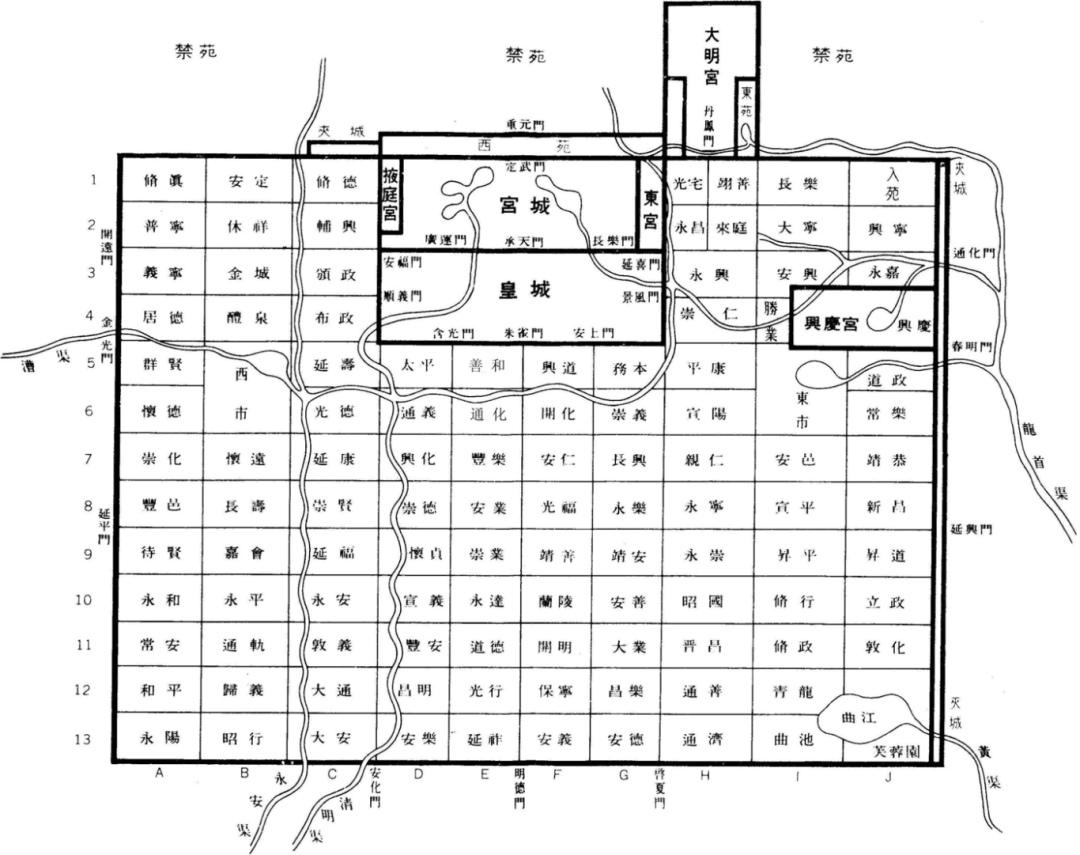
Figure 1 Chang'an Fangli Map
As early as 1933, Mr. Xiang Da published his famous article “Chang'an and Western Civilization in the Tang Dynasty”, which was based on historical materials and inscriptions found at that time, discussing the “Westerners living in Chang'an”, which involved people from the countries of Ü-Tsang, Guezi, Shule, Zhaowu and Persia who came to Chang'an [1]. 1978 Mr. Xie Hai Ping's book “An Examination of Foreigners' Life in China during the Tang Dynasty” describes the life situation of Fanhu in Chang'an from various perspectives, including Hu people who stayed in Chang'an [2]. In 1978, Mr. Xie Haiping wrote a book entitled “An Examination of the Lives of Foreigners in China during the Tang Dynasty”, in which he described the lives of the hu-tan in the Tang Dynasty from various perspectives, including the hu-tan who stayed in Chang'an [2]. In addition, there are many other articles dealing with this topic. In this paper, we make greater use of newly published inscriptions and documents in order to re-examine the traditional materials from the perspective of the hu people and give new interpretations.
First, the western region of hu people into the Chang'an
Chang'an hu people have some is the Tang dynasty's zongzong country sent to the hostage has not returned, there are also some is the Western countries of the emissary stayed not return, most of these people into the Tang dynasty Chang'an at all levels of government, and gradually become the Tang dynasty's officials (Figure 2).
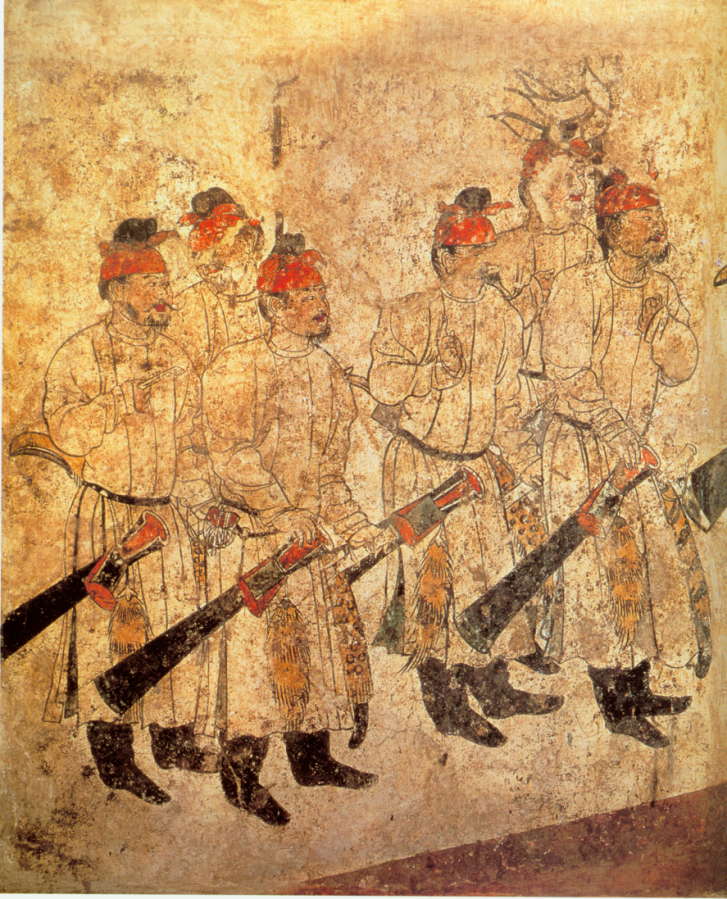
Fig. 2 Hu guards in the court of Tang Dynasty
Regarding the proton system, Mr. Yang Liansheng has a special article on it [3]. We can cite a few typical examples of protégés joining the court.
Li Su, courtesy name Wenzhen, was a native of Persia. His grandfather, Li Yichu, in the Tianbao years (742-756), “from the king's order, to pass the country good, to inherit my emperor's blessing, the charge of hostage, stop guarding China, listed in the military”, as a hostage to the Persian state, and many other hostages, as the Tang dynasty's guards, to “silver and blue Guanglu Daifu check school left scattered riding standing minister and right military guard general”. He stayed in Chang'an in the capacity of “Yinqing Guanglu Dafu Daifu Zuanshan Riding Changshu and Right Wuwei General”. His son, Li Zhi, became a special officer in Guangzhou, managing the local tombs. His grandson, Li Su, was transferred to Chang'an in the middle of the Dali period (766-779) with his special skills in astronomy and calendar, and served in the Sitiantai, and was granted a Zhuangzhuang house and a store in Jinggongli, and he lived in Chang'an for more than fifty years before and afterward, experiencing the emperors of the Dai, Der, Shun, and Xian dynasties, and finally, with the title of “Director of Sitiantai, and Chief Historian of Jinzhou, Hanlin, waiting for the edicts”, he died in the twelfth year of the Yuanhe reign (817). (He died in the twelfth year of the Yuanhe reign (817). All six of his sons joined the Tang dynasty, some as military generals, some succeeding the family as siantian officials, and the youngest two as temple officials [4]. The family made a smooth transition from hostages to Tang officials.
He Wenzhe, “Shih was a native of Lingwu. He was a fifth-generation grandson of King Pi of He, and his former ancestor came as a hostage to the royal court in the beginning of the Yonghui period.” (Figure 3) It can be seen that his ancestor, as a prince of the Central Asian state of He of Corn, was hostage in Chang'an in the early years of Gaozong's Yonghui reign (650). His father, He Youxian, was the governor of Lingzhou, so he was later registered as a native of Lingwu, and participated in the pacification of the Anshi Rebellion. He Wenzhe moved to Chang'an and lived in Yiningfang (Figure 4) in the northwest corner of the city, and since Emperor Dezong had been serving in the Chang'an forbidden army, where he had made many meritorious achievements, and “was rewarded with the title of Duke of Kaisoku of Lujiang County”, and died in the fourth year of the reign of Emperor Wenzong Daho (830). His eldest son, Gong Ben, was also named “Duke of Kaisoku, Lujiang County”[5].
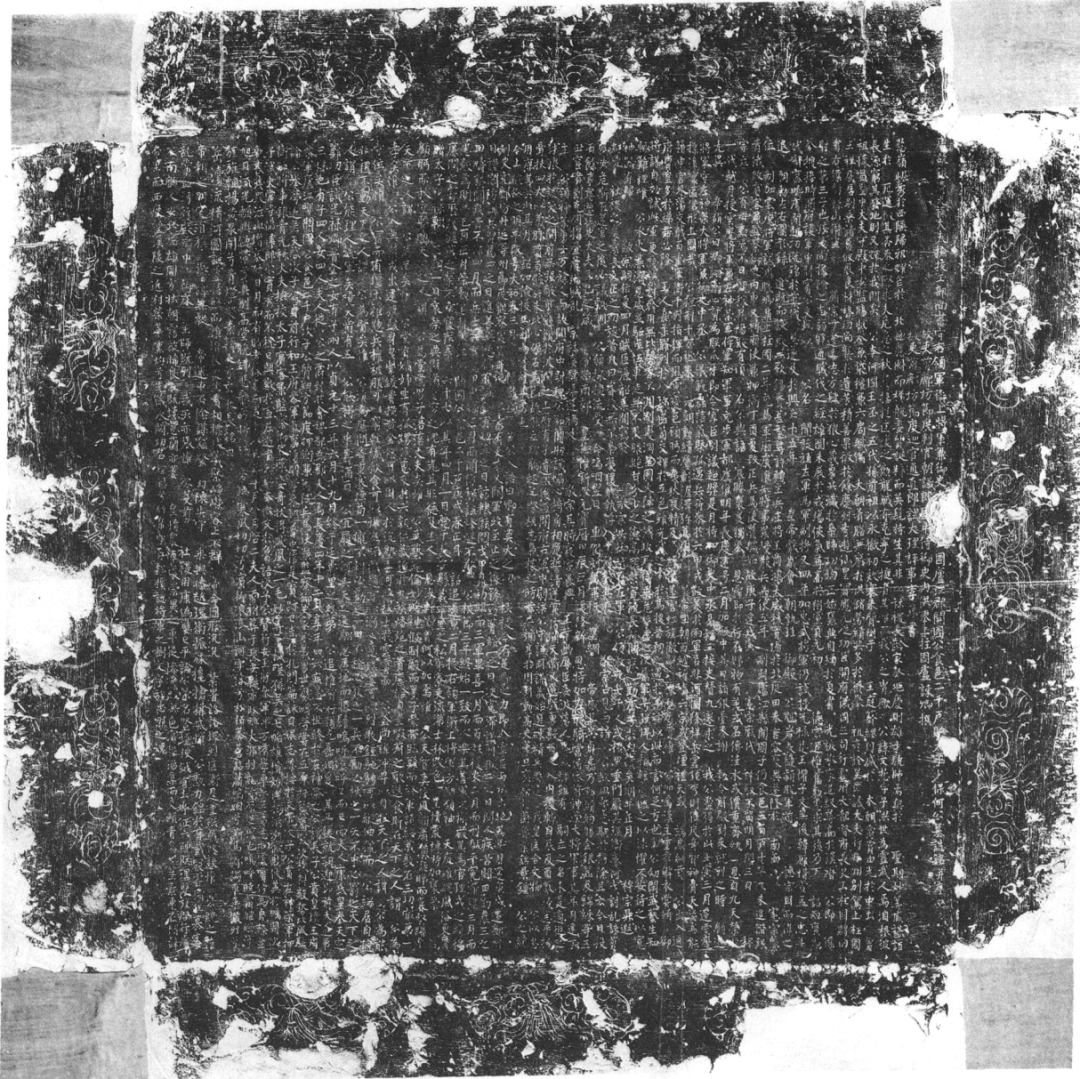
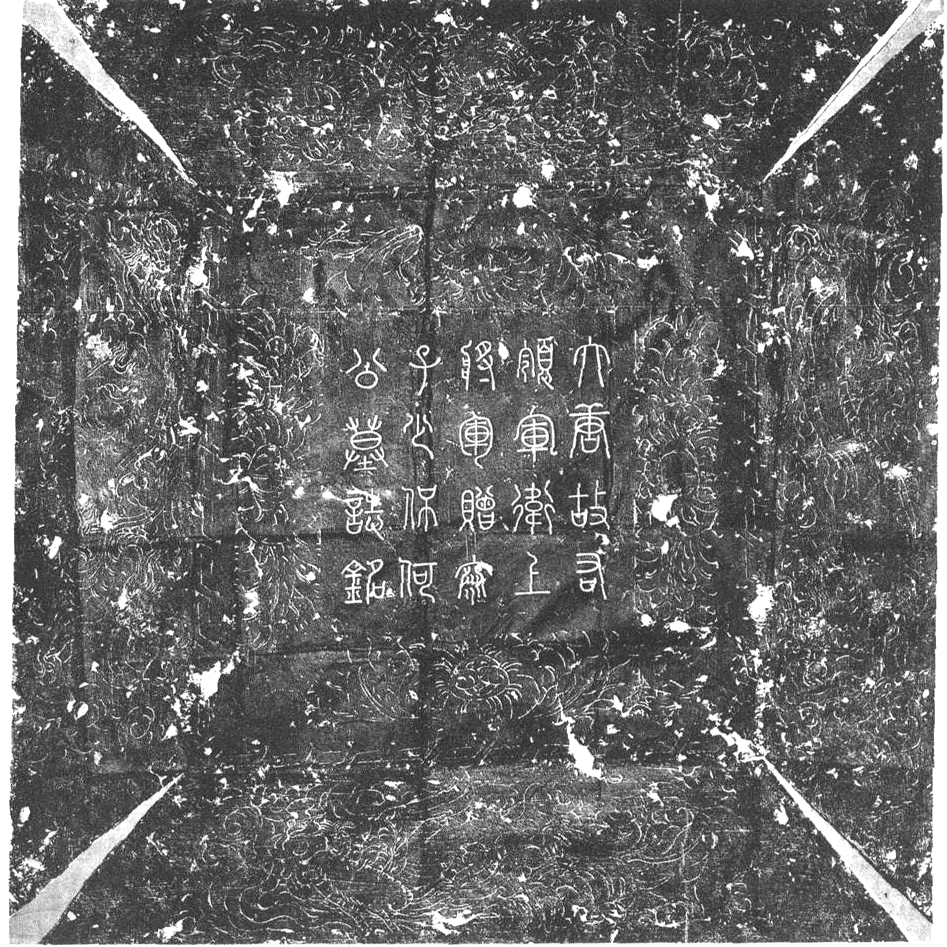
Figure 3 Tombstone of He Wenzhe (from Lu Zhaoyin's text)
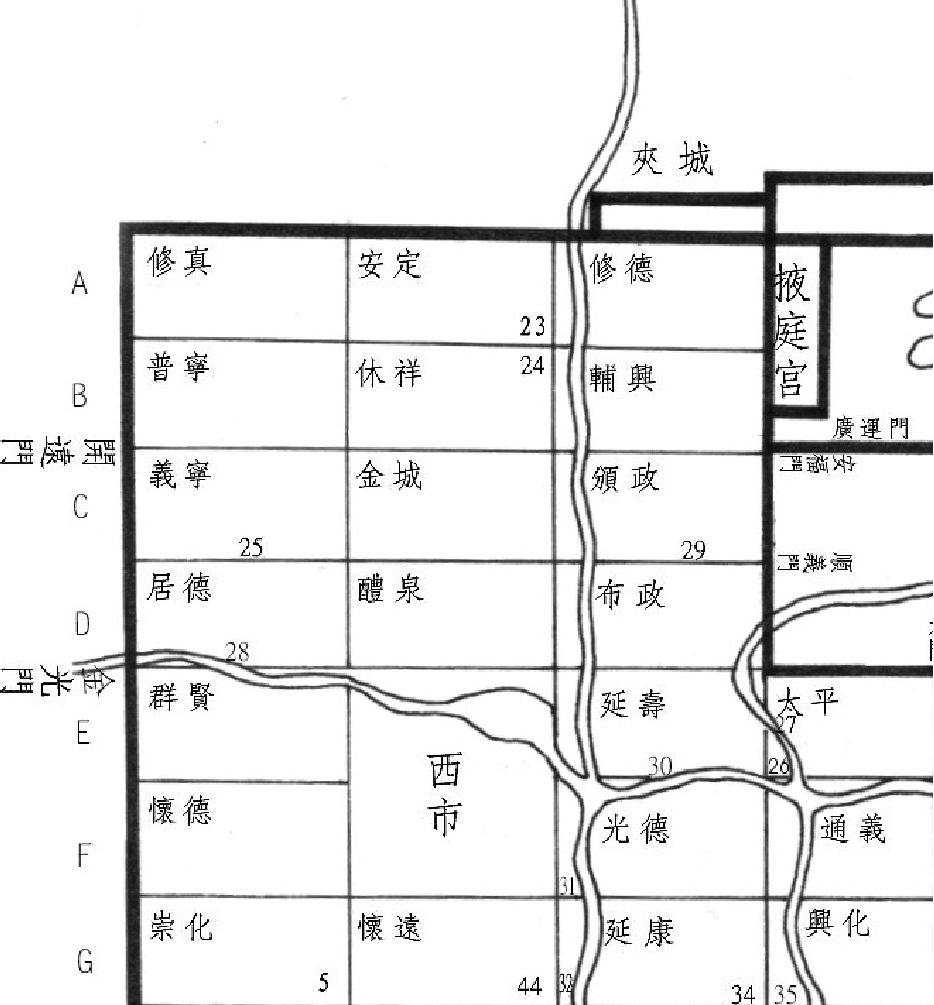
Figure 4 One of Chang'an Fangli
Mi Jifen, whose tombstone reads: “His ancestors were from the western region of Miguo. Generation for the head of the king, the family is not lacking in wisdom, the ancestor named Yi □, served as the country's long history. The father of the Tujing Shi, far from admiring the imperialization, came to the royal court. He came to the royal court to admire the imperialization of the country, and then he went to the capital, where he was forever connected with the country. Special favor, tired of practicing Ban Rong, successive auxiliary generals line left generals. Gong inherited the title of Prince and was in the forbidden army. Filial piety to honor relatives, loyalty to serve the country.” I know that Mi Jifen's ancestor came from the Western Cornucopia's Miguo, and he was the head of Miguo. His father's name Tu Jishi, may be the Turkicization of the corn, and then into the quality of the Tang Dynasty, in the capital successive General, the line of auxiliary generals, general of the left military guards. Mi Jifen inherited as a prince, serving in the forbidden army, as a general of the Divine Strategies Army. Yongzhen yuan (805) September 21 finally Chang'an liquanli private, ninety-two in the spring and autumn. His wife is also Mi, should be the same out of Mi. There are two sons: the eldest son of the name of the country into, as the right Shenwei army scattered generals, Ningyuan General, guarding Beijing Zhaofu Chongren Fu Folding Lieutenant with the positive, is still forbidden to the army generals. The second son, whose legal name was Hui Yuan, was a Nestorian clergyman at the Da Qin Temple in Chang'an[6].
These protégés did not return to their homeland in the Western Regions for various reasons, but stayed in Chang'an to join the civil service, and their children and grandchildren multiplied.
As for those from the western countries who did not return from their missions to the Tang Dynasty, there were not a few of them. The Ziji Tongjian Volume 232 Dezong Zhenyuan three years (787) July entry:
At the beginning, the river, Long both lost to the Tubo, since Tianbao, Anxi, Beiting Zaoji and Western envoys in Chang'an, return to the road has been cut off, the horses and men are all rely on the Honglu, the guest of honor commissioned by the government, the county for the, in the Duzhi to receive straight. Dushi from time to time to pay straight, Chang'an city does not win its ills. Li U know hukou stay in Changan for a long time, or more than forty years, all have a wife, buy a house, raise the quality to take advantage of, live in peace do not want to go back, ordered to check hukou have a house and field to stop its give. Where four thousand people, will be stopped. Hu guests are at the government v., said: “This is all from the Chancellor of the fault, there is no foreign tribute messenger to stay in the capital for decades do not listen to return to it! Today, when the false road back to Uighur, or from the sea each sent to the country. There are not willing to return, when the Honglu to present themselves, granting positions, pay as a Tang courtier.” So none of the hu guests want to return, all of them are subordinate to the two armies of the Shenze, Prince, messenger for the scattered soldiers and horses to make or escort the teeth, the rest of them are all pawns, forbidden brigade is stronger. Honglu give hu guest only more than ten people, the year to save money half a million coins, the city people are happy. [7]
It can be seen that, after the Anshi Rebellion, Tubo occupation of Hexi, Longyou, many emissaries from the western regions stayed in Chang'an, some are blocked by the road and can not return to their home countries, and some apparently because of the life in Chang'an is good and do not want to go back. According to the system of the Tang Dynasty, they had been supplied by the central government or local prefectures, which resulted in extra financial expenses for the Tang Dynasty. Some of the hucksters had been in Chang'an for more than forty years, marrying wives and having children, purchasing fields and houses, and engaging in the usury business for profit, disrupting the Chang'an marketplace. Therefore, the Tang government made an inventory of the ambassadors from the Western Regions in the third year of the reign of Zheng Yuan, and included a total of 4,000 of them, stopping the provision of those who were originally provided by the Honglu Temple and who had farms and houses in Chang'an, and letting those who did not intend to return to the country to be subordinate to the two armies of the Divine Strategies, and appointing those who were princes and official ambassadors to be the ambassadors of scattered soldiers or guards of teeth, and the rest of them to be the general ambassadors as the pawns. These 4,000 people were included in the Tang Dynasty, and there must have been some who had long since left the status of envoys and become residents of Chang'an, which means that the number was not small.
From the above tombstones and historical records, we can know that these Hu people became the registered people in Chang'an, had houses, most of them served in the forbidden army, and some of them served in the technical offices or served as clergymen of foreign religions.
Second, the western hu people in Chang'an socialization
Into living in Chang'an Hu people in the western region, in addition to the official, business and colonization, they also have what kind of life, it is worth exploring further. First of all, the Hu people were very active, and after entering Chang'an, socializing was an important part of their lives, as illustrated by the following two examples.
An Lingjie was a native of Guzang, Wuwei. Originally a native of An Guo, he entered China after the Wei Dynasty, and his ancestors served in Beijing and Luoyang, and later became a native of Yilu in Binzhou. An Lingjie did not hold an official position, but lived in Liquanfang, north of the western city, and was a wealthy merchant. In the fourth year of Chang'an (704), he was finally privatized. His tombstone is in the handwriting of Zheng Huowen of Xingyang, who was a scholar, and describes An Rinjie's deeds as follows:
He opened the house of Northern Ruan and took over the residence of his southern neighbor. The Zhai Gate attracted guests, and the seat of the scholar was not empty; the Sun Pavilion extended talents, and the post of that time was also placed. The golden saddle and the jade, even ride but not to pride people; painting dao milk 㹠, Chen Ding but not for the common people. The reputation of the county is high, and the name of the capital is moving. [8]
Here an allusion is used to boast of An Lingjie's social intercourse; he was like Ruan Zhongrong Rong Daobei's Zhu Ruan, as described in the Shishu Xinyao Renxian, who lived in a vast mansion connected with his southern neighbor's house; his doorway was like Zhai Gong's door, as described in the Shiji Kapuzheng Liezhuan, with its tepid door of guests; and the word “wenjue”, which is the character for Kong Rong, is also taken from the Shishu Xinyao, which says that there was no lack of such characters as Kong Rong. There was no shortage of people like Kong Rong. He was a chivalrous man who rode in and out of the country with a golden saddle and a jade horse, and was righteous and generous with his money, even though he had a thousand rides, which was quite chivalrous. Zheng Xiuwen praised him: “He was a man who was at home in the countryside, and did not draw from the rich and powerful; he was a man who hid himself in the city, and laughed in the mountains and forests.” Although he was a merchant without official rank, his family was rich, and the guests in Chang'an were willing to socialize with him, so his “reputation was high in the county and the country, and his fame moved the capital”. An Lingjie lived in Chang'an, “in the grotto of Chang'an's rogues, deeply contemptuous of the end of the stream; out of the door of the capital's rites and rituals, elegant and good Confucianism”. Emphasizing the Hu origin, he gradually dyed Han style, elegant and good Confucianism. This can be said to be a typical form of socialization of the Sut hu people who entered Chang'an. The fact that his son asked the Zheng family, a big name in Xingyang, to write his epitaph also shows that he had dealings with Han scholars; and the Shi Huobi, who wrote the inscription, came from the Bohai Sea, which indicates that he had a wide range of travels.
The early years of Goshu Han in Chang'an, a famous figure in the history of the Tang Dynasty, provide us with another kind of situation in which the Hu people socialized. The old book of tang volume 104 “goshuhan biography” records:
Goshu Han, Turkestan leader Goshu tribal descendants. Tomatoes more tribal name, because of the clan. Ancestor Frustration, Zuo淸道率. His father, Daoyuan, was the deputy governor of Anxi, and he lived in Anxi for many years. Han's family was rich in wealth, suave and chivalrous, good Ranno, indulge in sedges and wine. In his fortieth year, he suffered the loss of his father and lived in the capital for three years. He was not polite to the captain of Chang'an and was furious, and he fought for the sword in the west of the river. ...... Han's mother Yuchi's, Ütepe's family also. [9]
The New Tang Book, Volume 135, “Goshu Han biography” is much the same:
Goshu Han, its first cover Turkestan chief Goshu Department of descent. Father Dao Yuan, for the Anxi general, Chishui army, so still live in Anxi. Han less complementary effect hub (Valley) House of Fruitfulness, the family is rich in wealth, Reng Chivalry heavy RanNuo, longitudinal sedative wine Chang'an city, more than forty years, by the father's funeral, do not return, not for the Chang'an Lieutenant of the gift, indignation, touring the Hexi, the Ministry of the section of Wang Chixin. ...... Han's mother, the daughter of the king of Ütepe. [10]
Goshu Han was a member of the Goshu Department under the Turkestan, and his grandfather, Ren Qingdao, was a subordinate officer of the Eastern Palace of the Crown Prince of the Tang Dynasty, in charge of the internal and external day and night patrols, and was known to be a general of the Tang Dynasty's military service. Father Goshu Daoyuan once served as Tang Anxi section of the Deputy Secretary, married to the King of Ütepe's daughter, the world in Anxi. Here the “Anxi” is a general term, specifically should be the Anxi section of the deputy permanent resident of Ütepan [11]. Goshu Han is a Turkic, Iranian species of hybrids, his adolescence should grow in the western region, so “suave and chivalrous, good Ranno, indulge in sedatives and wine”, are the appearance of the Hu people. Later, in Shazhou (Dunhuang) effect Valley Province as a Folding House of the fruit of the Yidu, by his father's funeral should be dismissed, so living in Chang'an for three years, when he left Chang'an forty-three years old. According to “Tang Fangzhen Chronology”, Wang Ling served as the Heshi governor in the 29th year of the reign of Emperor Kaiyuan to the second year of Tianbao (741-743)[12], and Goshu Han's time in Chang'an was around 738-743. Goshu Han grew up in the western border area, and as a chivalrous man with a taste for wine, he was bound to cause trouble in Chang'an, so he was not treated with courtesy by the Chang'an magistrate in charge of public order, and traveled to the west side of the river with his sword.
Fortunately we can now read a record of Goshu Han's travels in Chang'an. TongYuLu (one for the “record of the Pantheon”) cloud:
Goshu Han when he was young, aspiring, Chang'an travelers heroes, house Xinchang Square. There is a favorite concubine said Pei Liu Niang, Rong Fan Kuang Dai, house in Chongren, Shu Han often pleased. [13]
Here said goshuhan traveled with chivalry, and the old and new “tangshu” record its “chivalry” consistent, that he was in changan with chivalry quite a lot of interaction. The chivalry in Chang'an was a special status, as summarized in Li Deyu's Treatise on Chivalry: “The chivalrous person is a person of extraordinary character. Although the promise of people with RanNuo, must be based on righteousness. Righteousness is not chivalry does not stand, chivalry is not righteousness not.” [14] Often righteousness, a promise of a thousand pieces of gold. Tang legend has many records [15]. We have arranged Goshu Han lived in Xinchang Square residents, before this is basically the residence of the poor, Turpan unearthed a number of pawnshop records, proving that the Gaozong when the square to the poor people. After the Anshi Rebellion, this place became a place where bureaucrats and literati competed to move to, like Bai Juyi purchased this square residence, because it is on a high slope, the water quality is good, and there are humanities and natural scenery such as Qinglong Temple and Bamboo Grove, plus the north side of the Daming Palace is not too far away from the pilgrimage to participate in the ceremony, and south of the literati like Leyouyuan and the Qujiang Pond [16]. When Geshu Han lived here at the end of Kaiyuan and the beginning of Tianbao, there should have been fewer bureaucrats here, and it might have been a meeting place for rogues. Goshu Han's concubine Pei Liu Niang, because and Ü-Tsang neighboring Shule country people into the Tang Dynasty are “Pei” as the last name, so I suspect that this Pei Liu Niang is Shule people, from the royal family or noble family, and Goshu Han in the Western Region, I am afraid that they have long known each other. She lives in Chongren Square, is the most prosperous place in the capital. “Chang'an Zhi” Volume VIII Chongren Square: ”North Street when the Imperial City of Jing Fengmen, and Shangshu Province, the closest election of the hospital, but also connected with the East City. According to the selection of the capital without a home, more rest here. Because it is the work of JIA spokes, so pouring the two cities, day and night clamor, lights are not endless, the capital of the neighborhoods than.” [17] (Figure 5) here is located in the Taiji Palace, Xingqing Palace, Daming Palace in the middle of the zone, and the East City adjacent, regardless of the court, and officials or life, are the most convenient, so it is also the place where the local jieduzhi into the concentration of the House of Ceremonies, or the candidates for the imperial examinations favorite place to rent, because every year the Shangshu Provincial Election of the House is the list of the place in this workshop. If Goshu Han wanted to find Pei Liuniang in love, he should go to Chongren Square to meet, where there are Bao Sha Temple, Zi Sheng Temple and Jing Long Guan, which was converted from Princess Chang Ning's house, to meet and play. It is conceivable that, in addition to being a wanderer, Goshu Han also spent the good old days of his youth in Chang'an.
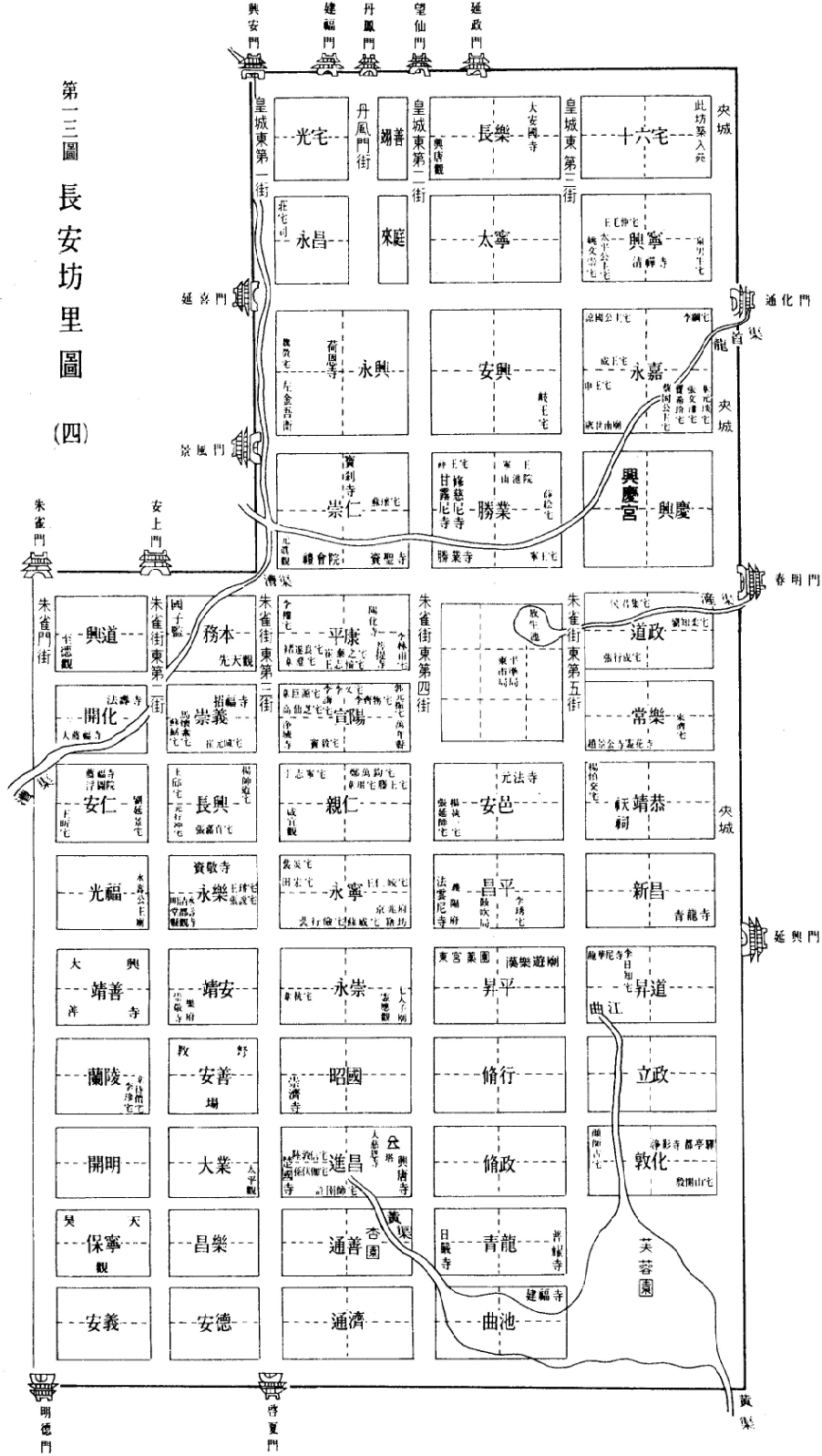
Fig. 5 Chang'an Fangli No. 2
Third, the study life of the Hu people in the western region
The tombstones of Čigil Hongfu and Čigil辿, father and son, discovered in recent years [18], together with the newly discovered documents in Turpan, provide us with a typical example of the process of the entry of the Hu people from the Western region into Chang'an as well as their study and life in Chang'an.
The Čigil (Čigil), also known as Job B, was a tribe subordinate to the Koglu (Ge Logolu) of the Tiele, Turkic system in the north of the Desert, mainly active in the area of Jinshan (present-day Altay Mountains in Xinjiang) between the Eastern and Western Turkic regions. In November of the second year of Gaozong's Xianqing period (657), the Tang dynasty completely defeated the Western Turkic Khanate, and set up tie-up prefectures to the north and south of the Tianshan Mountains, and to the east and west of the Onion Ridge, and the three branches of the Kogloglu “took the Ministry of Moulu as the Yinshan Prefecture, the Ministry of Khechigi as the Desert Prefecture, and the Ministry of Tatsuji as the Xuanchi Prefecture, that is, they used their chieftains as their prefects. Jinshan to the north and west of Tingzhou, on the banks of the Irtysh River.
Kesaki Hongfu grandfather name step lost should be after five years (660) after hereditary governor of the desert state. He was described as “the governor of the desert state, but he did not commit any offense, and he was overthrown”, and it is said that he served as the governor of the desert state, and then he entered Chang'an, the capital, to hold a post in the forbidden army, and later he was awarded the title of “right primus general, and the open state of Tien Shan county”. Tulufan new “Tang Longshuo two years, three years (662-663) west state governor's office case file for Anji brother logic Luo tribe” records, Longshuo first year (661) Jinshan west foot of the brother logic Luo Bufu loss Daguan tribe of 1,000 tents exiled to Tingzhou near the Ministry of the month of the jurisdiction of the Jin Manzhou, Tang west state sent people to Jin Manzhou arrangements for the return of the brother logic Luo tribe to the desert state governor's office residence [20]. Khechigi Bufu should be the leader of the Khechigi tribe and the governor of Damo Prefecture around the second year of the Longshuo reign (662). Longshuo two or three years of the document said that some of the leaders of the tribe of the Koromolu Bufu lost Da Guan into the capital did not return, that is, Killing Bufu lost into the court.
Kesaki Hongfu father Kesaki Li, “for the county governor”, that is, the governor of Damo State. Killing Yi 辿墓志》 also said: “Zu Li, Yun Hui General, left Wuwei Zhonglang General, and the county governor. Following the Shiguan, the county and state. Out is defending the city against insults, in is holding the sun and wearing the sky.” On the one hand, he was the general of the forbidden army of the capital, and on the other hand, he was still the governor of Damo Prefecture. Kesiqi force is likely to be with his father into the dynasty, stay in the capital, but also the governor of the desert state, which is obviously the Tang dynasty central control of the local nomadic tribes of a means.
Khechi Hongfu was known for his martial arts skills when he was young, and participated in the Tang Dynasty's crusade against the Ten Surnames (Western Turkestan) tribes, and was specially authorized to be a guerrilla general because of his superb achievements. Later, he became the captain of Henan Taolin Province, and then the general of the left primus guard. In the first year of Dengfeng (696), he was promoted to general of Yun Hui, general of Zuo Weiwei, and upper pillar state. Probably in the first year of the shengli (698) by imperial decree to charge the heavenly army marching deputy ambassador and recruited the three surnames of the Ge Logu Lu make, the mission to the western region, in dealing with the relationship with the sudden ride Shi Wu Qi Le by slander, depreciated for the imploration of herbs Herb Chuanfu folding Chong, still for the Lizhou and the set of the town of vice. More unfortunate, Shenlong two years (706) December 29 in the road in the structure of the disease, died in Jianzhou Jianmen County hostel, fifty-three years. Kiqi Hongfu apparently no longer served as the governor of Damo Prefecture, but rather as a military general in the Tang Dynasty.
The sons of Kiqi Hongfu all joined the Tang dynasty, except for some who were officials of the Zichongfu (折冲府), they all served in the forbidden army of the capital. Khe Qi辿wan Tongtian (696-697) was specially commissioned as a general of guerrilla, and a right general of the left Weiwei Yifu. In the middle of the Kaiyuan period (about 727), he moved to the left primitive guard. With the funeral of the Dowager Empress to leave the service. Kaiyuan twenty-five years (737) service shortage, reappointed right Wuwei Zhonglang. He died in Yi Ning Fang on April 17, 752, at the age of 69, in the eleventh year of Tian Bao.
There is a special record in the Kiqi辿墓志 (Figure 6):
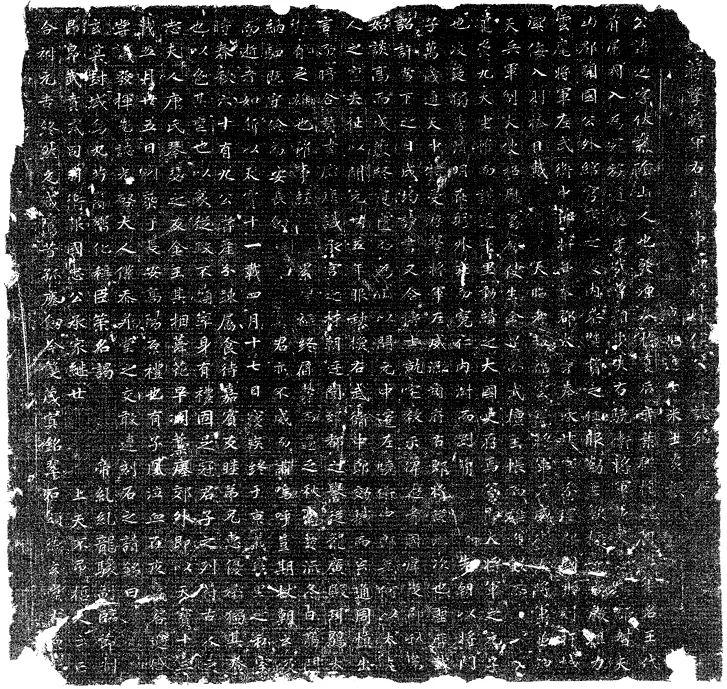
Figure 6: Tombstone of Blazing Ki辿(炽俟辿).
ShengLiLiLiLi, the imperial decree to allow the day of the present, into the average reading. And make the doctor on the house teaching, so that travel to your state zang, from the teacher of the private sector.
Although 炽俟辿 had been serving as the military general of the sixteen guards of the capital, it is obvious that the Tang dynasty intended to use Confucian education to reform these Hu generals from the desert north. Interestingly, during the Shengli years (698-700), the imperial court not only let them study at the National Academy, but also sent a doctor to tutor them in person at Kiqi辿's mansion [21]. From the epitaph, which reads, “He was a man who was able to understand Zhou and Shen in his work, and he was able to express his views in a way that was consistent with poetry and books,” it seems that he was quite effective. These nomadic people originally to martial arts, so successively served as the left primus guards, the right martial arts guards, are forbidden military officials, but they also gradually know the books and manners, into the literary and military people.
The Tombstone of Kang Wentong unearthed in Xi'an adds another example:
Epitaph for the Tomb of Kang Jun, the Late Division Officer of the Zhou Dynasty
Jun was a native of Gao Mi County, Qing Zhou, with the name of Wentong and the character Yi. His father, Luan, was a member of the Tang dynasty. His father, Luan, was a Tang dynasty official. Yiyi's family is a powerful one, and it is a prestigious family. Male material and quantity, the city of land and sea; ZuDe family style, TianJueSheng SanQin country. The doctor is a very high reputation, reputation of the western capital; the column of the state is Yingliu crown time, gas Ling South Chu. Public square flow of jade, round analysis of pearls. Yuzhang seven years, the tip of the floating clouds and the cage of the sun; Tianma thousands of miles, swim in the palace of heaven and watch the jade platform. Cultivate your body and practice what you say, and don't move if you are not polite. Warmth and humility, only righteousness and behavior. So he kept his eyes on the garden and his heart on the grave. I thought that Zizhong resigned from his post and filled the garden, and Joe Hanin forgot his chance and held the urn. The white jade tablet was unsullied, and the words of the three wai; the gold was full of chopsticks, but not as good as the business of a scripture. I have been studying poetry and etiquette, and have been advising my children and grandchildren. The art of Song Qiao has not yet been completed, and the period of spiritualization is far away. Spring and Autumn year seventy-nine, long live the Tongtian first year of the July 10th end of the Anyi Li's private, Yue to the Zhou Shen Gong first year of the year ding You October A Zi Shuo twenty-second day of the yiyou, buried in the Longshou Township, Wannian County, Jingzhao rituals of the border also.
Kang Wentong from the family name, the distant origin when from the western region of the state of Kang, but his ancestors have long entered China, and registered as the Qingzhou Gao Mi people, which can be seen from the “Wentong” such authentic Chinese name. His ancestor and father did not have high official positions, and neither of them was an official. At least in his ancestor, his father, has moved to Chang'an, the so-called “Heavenly Jade Sheng San Qin country”, “reputation of the West”. Kang Wentong himself is a “Division Shi”, there is no official position, but his tomb is a large slope before and after the chamber brick tomb, although the chamber was stolen, but the burial goods are very rich, unearthed a beautifully crafted gold-painted three-color figurines of heavenly kings, warrior terracotta warriors, tomb beasts, tall, colorful [22]. He should be the same as An Lingjie, engaged in commerce and become rich. The tombstone praises him “obscure the hill garden, pay attention to the grave book”, so he can “cultivate the body to practice the word, not polite immobility, warmth and humility, only righteousness and behavior”, but also “study poetry and etiquette, exhortation of the children and grandchildren”, just like a Chinese scholar with the Chinese scholarly tradition, the Chinese scholarly tradition, the Chinese scholarly tradition, the Chinese scholarly tradition, the Chinese scholarly tradition, the Chinese scholarly tradition and the Chinese scholarly tradition. He was a man of knowledge and propriety, just like the Chinese scholars. He died at the age of seventy-nine, in the first year of the reign of Emperor Tongtian (696), in Anyi Fang, Chang'an, and his place of residence was not one of the Fangs, where most of the merchants of the Sultanate gathered.
Whether passive acceptance, or active absorption, into Chang'an in the western region of the Hu people, there are a number of gradual Confucian classics to learn, and traditional Chinese poetry, rituals and music to regulate the behavior of the Chinese, gradually become authentic Chinese.
Fourth, the Western Hu people's garden management
In the end of the Northern Dynasty to the Sui Dynasty in some of the Suit hu people chiefs tomb, such as 580 years into the burial of the Anga sarcophagus screen (Figure 7), Liangzhou Sapao Shijun's stone outer coffin (Figure 8), there are depictions of the scenes of their life when they were alive, such as banquets and drinking, hunting, traveling, music and dance, etc. [23]. The most dominant of these images, located in the center, often depict the master and his wife feasting in a Chinese house with a hermetically-roofed roof and a Chinese-style courtyard with small bridges and streams in front of the door, which shows that these Hu chiefs were fond of Chinese garden-style homes.
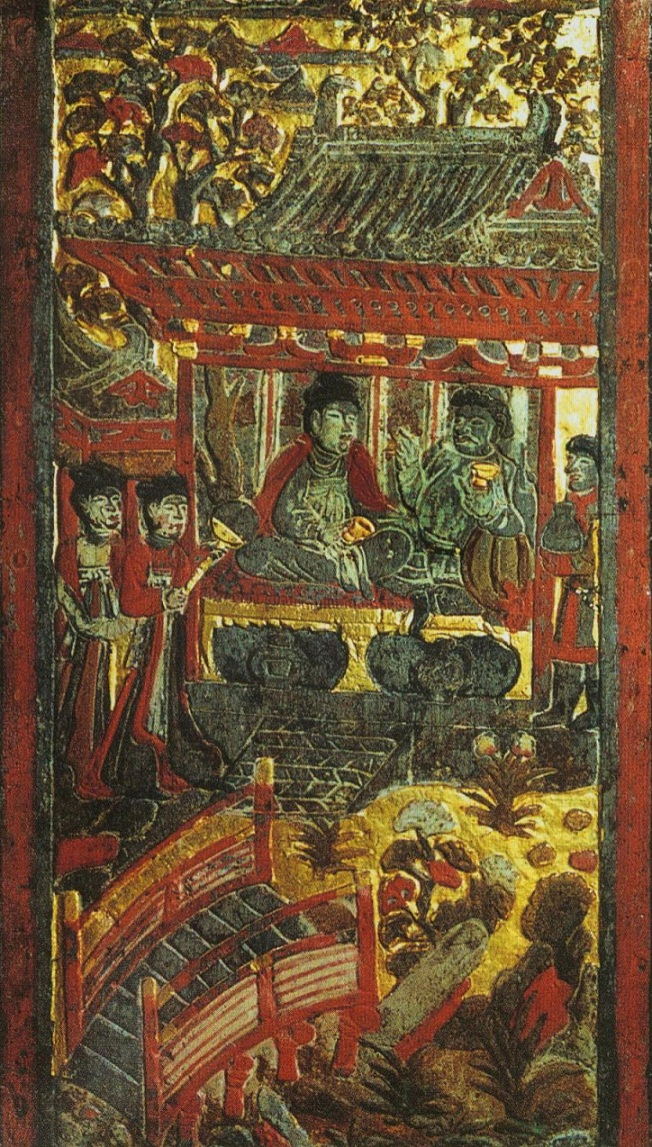
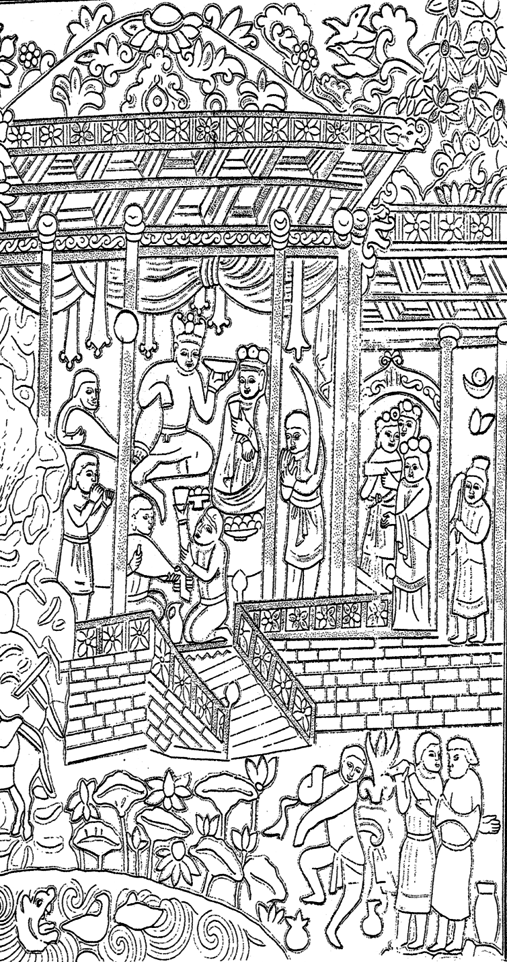
Figure 7(left) Anja sarcophagus screen banquet picture
Fig. 8 (Right) Shi Jun's sarcophagus with a banquet
What was the situation of the Sutis after entering the Tang Dynasty? Lines 114-126 of Dunhuang's P.3813, “The Collection of Judgments on Civilization,” record the image of a hu merchant who had already taken up residence in Chang'an:
Shi Batuo, a native of Chang'an, had a family of traders and was very rich. He was a primus, and his gardens, ponds, houses, clothes, utensils, servants and concubines were better than those of a marquis or a king. His brother, Jie Li, had been living away from his family for a long time, and his family was so poor that his brother did not give him any money. There is a neighbor, Kang Mo nose, can not borrow clothes, said illegal things. The five clothes have been Chen, with the classification of the different inferiority and superiority; Nine chapters have been revealed, I have built the upper and lower rituals. The morrow of the morrow market merchants, flag Pavilion Jah ere, family prestige lowly, the door and land cold and humble. Insulted the chapter, indulge in luxury and arrogance. So that the gold and jade heaps, no shame Liang, Huo home; Cherry colorful, there are more than Tian, Dou's room. Plum beams and laurel buildings were erected to the floating sky; embroidered jiaojiao and carved pillars, and the light of the sun was dazzling. Singing girls and dancers, twisting their arms to surprise the wind; knights and boys, turning golden saddles to shine the sun. [24]
The “Chang'an County” here refers to the western half of the outer city of Chang'an, in which the area around the Kaiyuan Gate, the Jinguang Gate, and the Xishi City was the area inhabited by the Sutis. This Shibata, whose name is probably transliterated from the Cornish word βnt'kk, i.e., “槃陀”, meaning “servant”, was from the Cornish country of Shi. His younger brother had the Turkic name “Jie Li,” which was a common practice among the Sut people, who were deeply influenced by the Turkic language, while his neighbor from Kang had the name “Mo Bi,” which came from the Sut word m'xβy 'rt, meaning “from the moon god”[25]. “Judgements are usually made on the basis of fictional characters, or sometimes on the basis of actual events that have already occurred. Although the characters in this judgment are fictionalized, the three characters represent three types of Chang'an Sute merchants, and similar cases should occur more often in the gathering area of Chang'an Sute people, which is why they are made into a judgment set for officials to use in judging cases. This case illustrates how rich Shibata, who started as a merchant, was, and how poor his brother was, so that his neighbor, Kangmobi, could not stand to see it and sued Shibata to the government. This shows the different living conditions of the Suthee inhabitants of Chang'an, and also the concentration of their dwellings. According to the Judgment, “the gardens, ponds, houses, clothes, wares, servants and concubines of the Chang'an people were more luxurious than those of a lord, with plum beams and laurel beams, and embroidered rafters and carved pillars, with a bright and glittering sky”, which is precisely the “gardens and ponds” as the first and foremost sign of their wealth. (Figure 9)
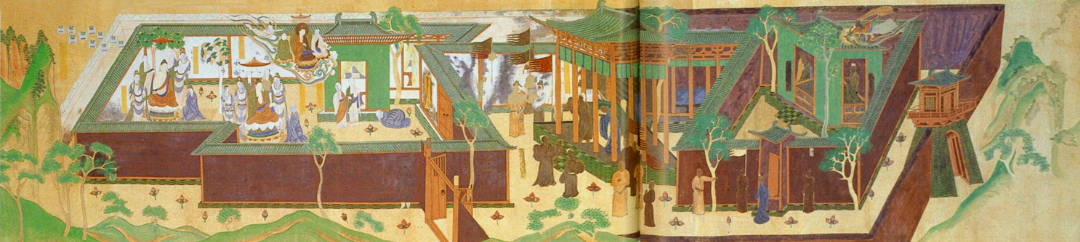
Fig. 9 Tang Dynasty houses in Dunhuang murals
We can also find two good examples in other historical materials.
Du Fu wrote the poem “Ten Poems on Accompanying Zheng Guangwen to General He's Mountain and Forest”, which was written by Zheng Guangwen, or Zheng Qi, who was known as “Zheng Guangwen” because of the establishment of the Guangwen Pavilion in the ninth year of Tianbao's reign (750), and the appointment of Zheng Qi as a doctor [26]. According to this time and Du Fu's subsequent entry and exit from Chang'an, it is generally believed that this group of poems was written in the twelfth year of Tianbao (753) [27]. General He, the owner of the mountains and forests, is generally said by commentators of Du's poems to be “unknown” [28], although their focus is on the mountains and forests themselves rather than on General He. Zhang Yonglu's Dictionary of Chang'an in the Tang Dynasty refers to him as “He Changqi, a famous general at the time of Tianbao” [29]. Xi'an Local History Museum and other editors of the Xi'an General View says: “During the Tianbao period of the Tang Dynasty, the famous general He Changqi built a villa in the upper tower slope, called General He Shanlin, which is a famous place in the south of Chang'an.”[30] However, it is not General He's villa, which is a famous place in the south of Chang'an. [30] But He Changqi, a native of Yangshan in Lingnan, was drafted into Guo Ziyi's Shofang army in Tianbao 14 (756), and was promoted to the rank of general of the Thousand Bulls Guards, and given the title of Ningguobo, after being meritorious in the pacification of An Lushan's rebellion [31]. But Du Fu's poem was written in the 12th year of Tianbao, in fact, He Changqi had not yet joined Guo Ziyi's army, nor was he a general, so I am afraid that He Changqi as “General He” in Du's poem is a fabrication of the celebrity effect.
I think “General He” was originally from the state of He in Corn, also known as Kushānika (屈霜你伽), about 75 kilometers northwest of Samarkand. The third poem of Du Fu's set begins, “Ten thousand miles of Rong princes, what year is the branch of the other month?” It is generally believed that the Prince of Rong here is a kind of flower or herb, or refers to “Dewo, a Qiang protector”[32], which is in line with the meaning of the poem that it comes from ten thousand miles away, but so far, no one has found this kind of herb with the name of “Prince of Rong”. I think here “Rong Prince” is a pun, on the one hand, is to say an exotic flowers and plants, but also refers to the person, that is, from the land of the Yuezhi king's son, in the Tang dynasty is the hostage. “Moon branch” that is, ‘the moon’, the northern dynasty sui and tang dynasties into China corn hu people claimed that they were originally with the moon people migrated to the western region, such as the ‘northern history - the western region biography’ kang state article said: ”the king of the family name of wen, the moon people, also, old residence Qilian Mountains, Zhaowu City, was broken by the Xiongnu, west over the Onion Ridge, and then there was a country. The branches of the populace were each divided into kings, so all the countries around Kangguo and Zhaowu as a surname, showing that they do not forget their roots.” [33] Also, “Miguo, Shiguo, Cao Guo, He Guo, Xiao An Guo, Naxepo Guo, Unaho Guo, and Mu Guo were attached to it.” [34] Although this is not necessarily the historical truth, it was the way the Hu people who entered China during the Sui and Tang dynasties saw it, so the Rong princes who left the Yuezhi, as Du Shi called them, would have been the princes of the Suit He state. The Anpo mentioned above, “Mrs. He, the eldest daughter of his first General He, was appointed as the Dowager Lady of Jinshan County,” which was a General He who entered China, but because his daughter had already died in Chang'an in the fourth year of her life (704), so she should not be the General He of Du Shi's poem. It is not known whether the General He of Du's poem is related to this General He, but there should be no question about his being the son of a king [35].
Du Fu's Ten Songs to Accompany Zheng Guangwen on a Tour of General He's Mountain Grove provides a detailed description of this mountain retreat:
One of them is: I don't know the road of Nantang, but now I know the fifth bridge. The famous garden is located on the green water, and the wild bamboos are on the green sky.
I have met with you in the past, and I have seen you in Hao Liang. I've been a fan of the idea for a long time, but I'm not ashamed to say that I've never seen the horse's hooves.
bis: A hundred hectares of windy pools, a thousand chapters of summer trees. The branches are low, the leaves are dark, and the nesting warblers are in the dark.
Fresh carp chopped with silver threads, parsley soup with blue streams. I wondered if I would ever be able to get to the bottom of Totaru and have a dinner in the middle of the country.
No. 3: The Prince of the Rons, when will you say goodbye to the moon? The flowers bloomed in a different region, and the vines spread in a clear pool.
The apostle of Han came to the city, but Shennong didn't even know it. The dew turns over and the rain hits, and the day of the opening of the chapel (a gradual) away from the phi.
Quaternary: The side house is connected with high bamboo, and the sparse hedge with evening flowers. The vines are so curved that they hide snakes.
I have no credit for my work in the mountains and the forests. I have been selling books and have come to ask the proprietor of the house.
Fifth: The remaining water of the Cangjiang River is broken, and the remnants of the mountain Jieshi are open. Green bamboo shoots are broken by the wind, and red plums are fattened by the rain.
The silver armor is used to play the kite, and the gold fish is exchanged for wine. I am not going to clean up, but I will sit on the berry moss at my own will.
Sixth: The wind and snow are blowing from the cliffs, and the waterfalls and springs are roaring from the cloud gate. I woke up thinking of lying down on a woven grass mat, and my clothes were cold, so I wanted to put on some silk.
The wild old man came to see the guest, the river fish did not take money. I only suspect that the simple place has its own mountains and rivers.
Seventh: spiny tree cold cloud color, artemisia spring lotus root fragrance. Crisp add lettuce beautiful, Yin benefit food list cool.
Wild crane early in the morning, mountain essence white sun hide. Stone forest coils waterfu, hundreds of miles alone pale.
No.8: I remembered Yang Liuzhu, walking on horseback to set Kunchi. Drunkenly put the green lotus leaves, wildly left the white pickup.
I'm not sure if I'm going to be able to do this, but I'm going to be able to do it, and I'm going to be able to do it. Sitting on the Qinshan evening, Jianghu Xing quite with.
Nine: The books on the bed are connected to the house, and the trees in front of the steps brush the clouds. The general is not good at martial arts, but the child is always able to write.
I'm not sure if I'm going to be able to do this, but I'm sure I'll be able to do it. Clothes hanging Ficus Luo, cool moon white have.
No. 10: I'm not comfortable with the idea of returning to my home town. I'm not sure what I'm talking about, but I'm sure that I'll be able to find a way to make it work.
I've laughed at the dance in front of the lamp, but I don't know who's going to sing when I'm drunk. I should only be good with my friends, the wind and rain also come over. [36]
Regarding the overall lineage of the poems, Xie Siwei's “Notes” cites Zhang Qianyi's “Poetry Talks of the Jiezhai”, Volume 4, as follows: “‘Touring General He's Mountain and Forest’, when viewed together with the ten poems, the chapters do not have to be dead-on-arrival, but one sentence is indispensable. The first is to see from a distance. The second entry to look carefully, and the forest supply. Its third single pick a flower, for its heterogeneous also. The fourth and turn into the garden of the bookstore. The fifth is a description of the wigwams and ponds, and the second is an account of the elegance of the hospitable treatment. Sixth, after a drink to get up, feel free to climb, that is, a stone step and a spring can also be appreciated. The seventh narrative before the beauty of the product, after the situation of the great extreme. The eight borrowed to set Kun Chi to compare the pool of He's, because and stab the boat to solve the water play. Its nine single sponsor of the wise, if not the landlord of the good Shi, the literati can not stay long. This is the heart of the first ten. Its eleven folded outside the Bureau, the body is gone and the heart is still tied, then the root of the ambush heavy over. This is also a fixed pattern of several songs.” The overall structure of Du's poem and the general situation of General He's mountains and forests can be seen (Fig. 10).
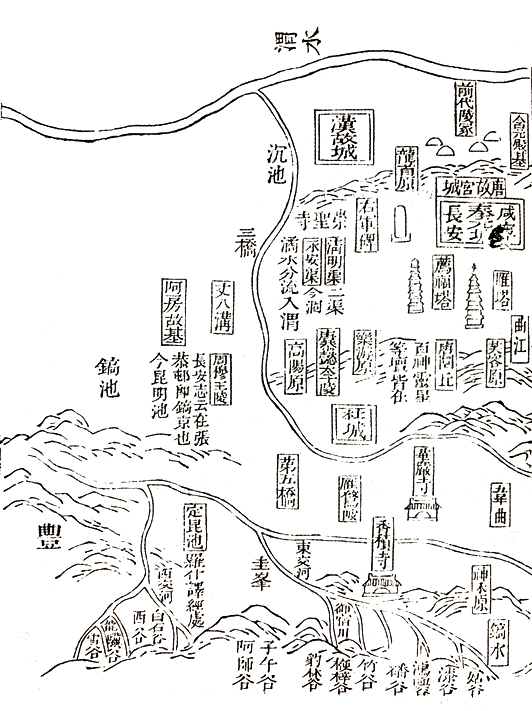
Figure 10 General He's Mountain Forest
Du Fu also has “Five Songs on Re-exceeding He”, which was written in the spring of Tianbao 13 (754), according to the article's seasonal scenery examination [37]. The poem Yun:
One of them: inquire about the East Bridge Bamboo, the general has a report. Pouring clothes also ordered to drive, high pillow is my hut.
Flowers proper warbler piggyback butterfly, stream clamor otter while fish. Come back to the resting place, really a wild man living.
bis: The mountain rain is still in the bottle, the sand is sinking and the couch has not been moved. Dogs welcome former guests, and crows protect children who have fallen from their nests.
The clouds are thin at Cuiwei Temple and the sky is clear at Huangzi Pei. I have always been so excited that I walked on shoes and passed through the East Fence.
ter: On the platform at sunset, sipping tea in the spring breeze. The stone fence is pointing the pen diagonally, and the tung leaves are inscribing poems.
The jadeite is sounding in the clothes, the dragonfly is standing on the fishing line. Since then, I have no time to come and go.
quater: I am not too lazy to go to the temple, but I should have been interested in the wilderness. The rain throws the golden armor, the moss lies on the green sunken gun.
I've moved my hand to the willow, and I've got enough rice sorghum for my family. If you use your mind, you will be able to reach Hsi Huang in the daytime.
No. 5: You should always stay here, and we can judge each other's years. I am wasting my time in the twilight, and I am disappointed to see the good forest and spring.
When will I get a little money and go back to the mountains to buy a thin field? I'm afraid that I won't be able to make it, so I'm going to drink my wine in a daze. [38]
Unfortunately, the forest was probably destroyed during the An Shi Rebellion, and the place where the garden was located was the site of a fierce battle between the Tang army and the rebels in the process of recovering Chang'an, so it is assumed to have been destroyed during this period, and there is no record of it in the documents of the Middle and Late Tang dynasties. Northern Song Dynasty Zhang Li Yuanyou first year (1086) traveled to the south of the city of Jingzhao, in the compilation of the “tour of the south of the city,” remembered the cloud: “visit Han, Zheng suburban residence, to the Weiqu, buckle Yaofu door, on the free public reading platform, looking for the so-called General He forests, but can not be seen. Because of the Tang people living in the south of the city, often the old traces of obliteration, nothing to seek, is not better than hate.” The forest is no longer visible. Zhang Li note cited Du poetry mentioned the name of the place, said: “now the fifth bridge in the west of Weiqu, and Shenjiaqiao similar. Tingkun Pond in the north of Wei Qu, Yang Liuzhu is not available today. Nantang, according to Xu Hun's poem 'back ridge pillow Nantang', it is also in the Weiqu of the left and right?” [39] to the Yuan dynasty Li Hao Wen compiled “Chang'an Zhitu”, the volume said: “Hanzhuang, in the east of Wei Qu. Zheng Zhuang and in its southeast, Zheng Zhuang and in the east. Zheng Zhuang and in its southeast, Zheng eighteen pious residence also. It is said that the tower slope, named because there is a pontoon, in the west of Wei Qu, General He's mountain forest also.” [40] refers to General He mountain forest in the tower slope. Yuan Luo Tianchong “class compilation Chang'an Zhi” Volume IX records: “General He Shanlin, now called the tower slope, Shaolingyuan Nai Fanchuan of the North Plain, since the Sima village, to this end, its height of three hundred feet, in the east of Ducheng, Weiquan of the West. The mountains and forests have long been abolished, on which there is a temple, the floating map is also abolished, commonly called for the tower slope.” [41] Xiao Di Fei, “Du Fu full collection of school notes” I: “now five miles southeast of Chang'an District, Xi'an City, there is a place called Shuangzhu Village, from which trace the Fanchuan River southeastward, over the Shenjiaqiao, there is a place called Hejiaying, which is rumored to be the former site of the General Why mountains and forests.” [42] is already rumored to be cloudy. Shi Nianhai, Cao Erqin in the note “tour of Chengnan record”, test the fifth bridge for the Yongan Drainage Bridge, Drainage through the village of today's Fu Zhang west, and northeast through the fifth bridge, bridge in today's west five bridges east of the village; fixed Kun Chi in today's river pool Zhai, an area of several miles; Nantang when the present Weiquanan [43]. From this can be roughly launched General He Shanlin location, that is, Chang'an city south of the Mingde Gate outside Fanchuan Beiyuan, from the Mingde Gate about 30 miles west of Weiqu [44]. Here is the city of Chang'an in the Tang dynasty officials and aristocrats in the garden of a place of concentration, the so-called “Beijing suburbs of the shape of the victory also” [45]. The fact that General He built his estate in this area shows that he had strong financial strength and extensive personal connections.
Combined with the content of Du Fu's two sets of poems, Li Lingfu wrote Elements and Layout of General He's Garden in the Southern Suburbs of Chang'an City of the Tang Dynasty, for the house buildings and artifacts in the mountains and forests, such as the study, the watermill, the martial arts arena, the fishing platform, and the Bi-container drink; the mountains and forests in the mountains and forests, such as the Soap River, the Qingming Nullah, the Wind Pools, the Wigwams, the Cascade Springs, and the Shilin Shui Fu; and the mountains and forests in the mountains and forests of the flora and fauna, such as the fishes, the birds, the dogs, the dragonflies, the butterflies, the otters, the bamboo forests, and the soaking trees, Water Celery, Dokuroku, Red Plum, Lotus, Echinacea, Artemisia, Female Luo, Ficus, Pope and Willow, Rice; food, such as the fresh Carp of Webster, Parsley Soup, Artemisia, Spring Lotus Roots, Tea; as well as Drums and Music, etc., all made a categorized exposition. He analyzed the overall layout and detailed carvings of General He's mountains and forests from Du Fu's careful description [46]. From this, we can learn in detail how General Sut Ho constructed his own garden in accordance with the garden pattern of the Central Plains, skillfully utilizing the mountainous terrain and water channels in the southern part of the city. The operation of the scenery in the courtyard and the arrangement of the study and the martial arts field all reveal the owner's cultural mood of being both a scholar and a military man and approaching nature with the help of the garden. This can be said to be the western region of hu people in Chang'an cultural transformation of a representative group of buildings.
The same situation can also be cited as an example of King Yuchi Sheng of Ü-Tsang. The Old Book of Tang, Volume 144, Yuchi Sheng's biography records:
Yuchi Sheng was the eldest son of King Gui of Ütepe. He inherited the throne at a young age. Tianbao in the dynasty, offering famous horses, beautiful jade, Xuanzong Jia, wife to the clan female, authorized right Weiwei General, Vishafu Governor returned to the country. With the Anxi Festival Minister Gao Xianzhi with the breakthrough of Sabaibi, broadcasting Xian, to merit the addition of silver and green Guanglu Daifu, Honglu Qing, changed Guanglu Qing, all with the positive. In the beginning of the Zhide, heard that An Lushan against, Sheng Nai ordered his brother Yao line of state affairs, since the rate of 5,000 troops to go to the disaster. The people of the country stayed Sheng, with a young girl as a hostage and then line. Emperor Suzong treated him very kindly, and he was authorized to be a special grade, and a supervisor in the temple. In Guangde, worship Hussar General, Visha House Governor, King of Ütepe, to return to the country. Sheng solid please stay in the guards, plus open house Yitong three secretaries, sealed wudu king, real hundred households. Sheng requested that Yao be authorized by the king, and the imperial decree was granted. Sheng Nai in the capital city practice Li Sheng decorative forest pavilion, in order to treat guests, good people visit. [47]
According to the Book of Books Yuan Gui (册府元龟), Volume 9622, “The Department of Foreign Ministers - Xian Xing Men”: “Yuchi Sheng, the protégé of Ü-Tsang, was also.” [48] It is known that he also lived in Chang'an as a hostage, but returned to his country to inherit the throne at a young age. He had also come in person to make offerings to the imperial court at the time of Tianbao, and took a daughter of the Li Tang clan as his wife. After An Lushan's rebellion, he led 5,000 soldiers to the Central Plains to serve the king, but after the war, he did not return to his country and asked to stay in Suwei, but the Tang Dynasty still let him “know the affairs of his country”[49]. In the second year of Guangde (764), Emperor Daizong sent Sheng back to his country, and he simply gave the throne of his country to his younger brother, Yuchi Yao [50], and remained in Chang'an. Instead, he built large forest pavilions in Chang'an's cultivation workshop to entertain his guests. The New Book of Tang, Volume 110, “Yuchi Sheng biography” here says: “Sheng stayed, is wearing building pools and pavilions, thick guests, the scholarly public more from the tour.” [51] indicates that its forest pavilion is artificial through the building, there are ponds, there are buildings, and the people who traveled with it are mostly the capital scholar. Cultivation Square in the southeast of Chang'an City, seemingly remote, but here to the east is Leyouyuan, south is the Qujiang Pond, southwest of Jinchangfang has Da Ci'en Temple, then south is the Apricot Garden, and here the terrain is spacious, smooth water channels, is very ideal for the city to build a garden of a good place to go (see Figure 5 above). This area had the highest concentration of literati and bureaucrats, so it was also the best area to socialize with the scholars.
The Old Tang Book, Volume 144, Yuchi Sheng biography records: “the beginning of the Zhenyuan period, Yao sent an envoy to submit a petition, saying that since the beginning of the country, in order to succeed the first heir, brother Sheng that is to let the country, please pass on the Sheng son of the Rui. On was to Rui for the inspection school Guanglu Secretary and Visha House long history still. Solid resignation, and said: 'Yao long time to do state affairs, people are pleased to serve, Rui was born in Beijing, do not learn the national customs, can not be sent to.' Because of the Shao Wang consulting. Brothers let the country, many people say.” [52] The so-called “brothers let the country” was obviously a compliment from the Han scholars to Yuchi Sheng, the king of the Hu people, who was labeled as a noble person with Confucian moral values. It seems that Yuchi Sheng had made a success of his gardening and socializing with the scholars in Chang'an. His son also grew up in Chang'an, and by the tenth year of Zhenyuan (794), Yuchi Sheng died at the age of sixty-four, and was given the title of governor of Liangzhou, which was succeeded by his son, Yuchi Rui [53].
Summary
In this paper, we make use of the materials of newly published inscriptions and documents, and invent with the documents that have been handed down to us, to describe the situation of the Hu people from the Western Regions who entered the capital city of the Tang Dynasty, Chang'an, through multiple paths, especially their entry into the civil service, study, socializing, and construction of gardens after entering Chang'an, so as to see how the Hu people from the Western Regions were gradually integrated into the society of Chang'an, and how they made use of the traditional Chinese Confucian values in their study and socializing, as well as how they They also see how they utilized traditional Chinese Confucian values in their studies and interactions, and how they made use of the elegant life of gardens to socialize with the Tang scholars, and finally became completely integrated into the upper class society of Chang'an in the Tang Dynasty. These typical cases also provide a perspective for us to observe the gradual transformation of Chang'an society after the Anshi Rebellion, and they, as a special category of characters in Chang'an, were a strong driving force for the advancement of the rich and diversified cultural life of the city. (Figure 11)
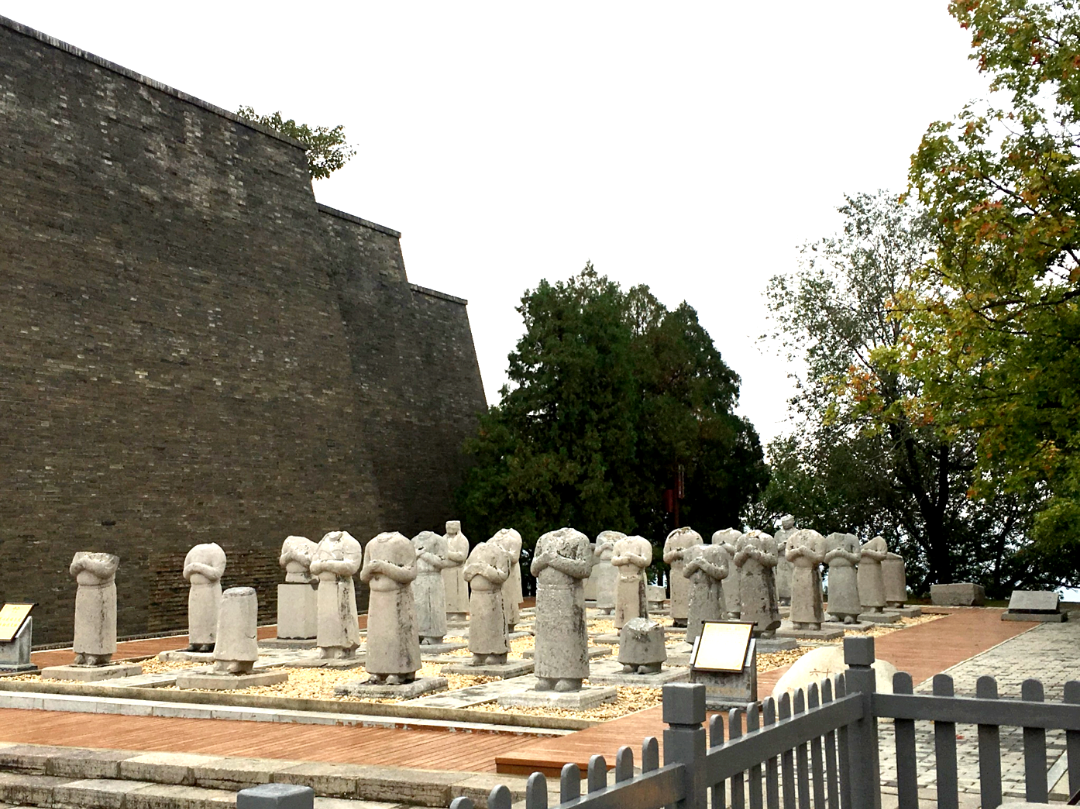
Figure 11 Qianling sixty-one monarchs long statue