

The Spread and Influence of the Sultanate along the Silk Road
Abstract: As a commercial people and immigrants, the Sultans had more activities along the Silk Road in the Middle Ages, and their footprints can be seen in the north of the desert and in the south of the Yangtze River and Huaihe River. These activities promoted the cultural exchanges between the East and the West, and especially played an important role in promoting the economic and cultural development of the northern peoples. As the carrier of the Suit language, widely spread and used along the ancient Silk Road, after the introduction of the desert, directly contributed to the creation of migratory birds, and migratory birds contributed to the formation of the Mongolian language, and indirectly contributed to the creation of Manchu and Sibe, the creation of Qidanese language is also affected by the migratory birds. 10-11 centuries later, the Suit language gradually declined and even gradually disappeared, but its influence has always been After the 10th and 11th centuries, the Suit language gradually declined and even disappeared, but its influence has been long-lasting.
Keywords: Sut; Sutwen; migratory language; Silk Road
I. The Sut people and their activities along the Silk Road
Sut (Sugda, Soɣd), translated into Chinese as Suyi, Genuine Carefree, Su Allium, Sut, etc., was the name of the region inhabited by the ancient Central Asian people of Iranian origin, the Sut, in the Middle Ages. The word “Sut” is said to be derived from a common Iranian root meaning “shining” and “burning”, and in the Tajik-Persian vocabulary meaning “watering hole”, and in the Chinese language, “Sut”, “Sut” and “Sut”. in the Tajik-Persian vocabulary, meaning “watering hole”. The Sut people mainly live in the Zerafshan River basin between the Amu Darya and Syr Darya rivers. The Zerafshan River is about 650 kilometers long from east to west, and there are many oases and irrigation canals along the river. The land is fertile and rich in produce, especially melons and wine. Since the 5th century B.C., the towns of Maraganda, Afrasiab, Warakhsha, and Abusi, with the first two forming the state of Kang, and the latter two forming the state of An. The 6th to early 8th centuries were the most economically and culturally advanced period in the Sut region, and in addition to the first two kingdoms, Kang and An, other city-states existed, such as Shi-guo, Mi-guo, Shi-guo, He-guo, and Cao-guo, etc. It is said that the inhabitants of these city-states started their lives in the first place, and that the first people who lived in these city-states were the people who lived in the first place. It is said that the residents of these city-states began to live in Qilian Mountains, north of Zhaowu City, was broken by the Xiongnu, west of the Onion Ridge, arrived in the Cornucopia region, the branches of the people are all to Zhaowu as a family name, to show that do not forget their roots, the history of the so-called “Zhaowu nine surnames”. The New Book of Tang” in addition to the above seven countries plus Huo Xun, Wudi and collectively referred to as the Zhaowu nine countries. According to the “Northern History”, “Sui Book”, the king surnamed Zhaowu also has a small Anguo, Na Seibo, Unaho, Mu Guo, 䥽 Khan and so on. As for the exact meaning of Zhaowu, there is still no satisfactory explanation. In Chinese historical records, the Sut people were also called the Nine Surname Hu and the Bastard Hu.
Between the 3rd and 8th centuries, known for good business in the world of the Sut people, driven by commercial interests and the Sut region under the influence of war and other factors, along the Silk Road gradually migrated east, so that migrated to the Central Plains, and to the neighboring extension of some areas gradually began to settle down to live in the formation of settlements. This trend in the Wei, Jin and North and South Dynasties have been developed, to the Tang is to reach a climax. The distribution of the Suthee settlement, mainly to the Central Asian homeland, Turkic, Hui migratory Khanate as a starting point, was from west to east, from north to south extension. Distribution area is more and more extensive, more and more decentralized. [1]
Before the Tang Dynasty, the trajectory of the Sutis into China was mainly along the traditionally land-based Silk Road traveling eastward in large numbers, trading and conducting business along the way. After a long time of operation, between Samarkand and Chang'an, and even as far as the border zone of northeastern China, gradually formed their own trade network, and in the intersection of this trade network, established settlements, as their east-west trade transit station. Turpan unearthed in the Gaochang Kingdom period of the “Gaochang Neizang Zodai said price account”, reflects the Gaochang region in the precious metals, spices and other trade on both sides, almost all of them are Sut. [2] A large number of Persian silver coins and a small number of Roman gold coins found along the northern Silk Road are also evidence of the trade of the Sut people, rather than the Persians and Byzantines who were the source of the coins. [3] From the period of the Sixteen Kingdoms to the Northern Dynasties, the eastward migration routes of the Sut people were generally as follows: from the Northern Western Regions, according to Shide (present-day Tumushuke City, Xinjiang), Guzi, Yanqi, Gaochang, and Yizhou, or from the Southern Regions, such as Ü-Tep, Andmā, and Shichengzhen (Shanshan County, Xinjiang), they entered the Western Corridor, took Dunhuang, Jiuquan, Zhangye, and Wuwei, and then southeastward, through Yuanzhou, to Chang'an, and Luoyang, or northeastward to Lingzhou, andzhou, andzhou, and even Yūshou and Yingzhou, or from Luoyang, and then northeastward, to the Western Regions. Yingzhou, or from Luoyang, via Weizhou, Xiangzhou, Weizhou, Xingzhou, Dingzhou, and Youzhou to Yingzhou. Almost all of the major towns along this road have left the footprints of the Sutis, and some have even formed settlements. [4]
The Tang Dynasty was an important period for the entry of the Sutis into China and their integration into Chinese society. During this period, the entry of the Sutis into China was freer in form and expanded geographically. The distribution of the Sut people's settlements basically tended to stabilize, and the distribution of the settlements was mainly in the areas along the Silk Road and radiated to the neighboring areas, one of which penetrated into the Jianghuai area, especially some of the center of commercial trade, and the geographical distribution of the Sut people formed several important areas, in short, the main areas around the Tarim Basin in Xinjiang, the Heshiguan Corridor, the Chang'an-Luoyang area, the six Huzhou Hebei and its surrounding areas, the Jianghuai area, and the Sut people's settlements in China. The main areas were the areas around the Tarim Basin in Xinjiang, the Hexi Corridor, the Chang'an-Luoyang area, the Six Huzhou Hebei and its surrounding areas, and the Jianghuai area. These areas were either major commercial routes or commercial towns, supply stations for long-distance trade and markets for transit trade, and the Sut people chose them as their settlements in line with their commercial ethnic identity. The literature, cultural relics, grotto inscriptions, and tombstones unearthed and discovered in these areas all reflect, to a greater or lesser extent, information about the Sut people and the Sut language. [5]
Since the Han and Wei dynasties, official and private contacts between the Sut people and the Central Plains had already taken place, a trend that continued in the Wei, Jin, and North-South dynasties and reached a climax in the Tang dynasty. Due to the role of many internal and external factors, in the Tang Dynasty, a large number of people in different ways into the territory of the Tang Dynasty, along the Silk Road and the interior of some commercial cities gradually formed a series of ethnic settlements. The distribution of these settlements is characterized by almost all of them are concentrated in the important northern trade routes, which are the supply station of long-distance trade and the market of transit trade, and the Sut people in them are engaged in trade to make profit on the one hand, and on the other hand, they act as the guarantor and interpreter in the contract of commodity sale, which creates the conditions for the use of the Sut language and characters, their dissemination, and the cognition of other nationalities. The Sut people also utilized their linguistic talent to act as messengers of various nationalities' missions. In the second year of the Western Wei Dynasty (553), the leader of the Tugukhuns, Kua Lü, made an envoy to the Northern Qi Dynasty, and the Tugukhuns' envoys included 240 merchants from the Western Regions,[6] and there was no lack of Sutis in the envoys sent by the central Chinese dynasties to the ethnic minority dynasties. The above circumstances made the Sut language the international language of the time, and the Sut script was the common script among merchants of various nationalities. Cornish was once commonly used in Central Asia, and it played an important role as a common language for commercial and cultural exchanges in ancient Central Asia in a vast area stretching from Persia in the west to northwestern China in the east.
II. The Use of the Cornish Language along the Silk Road
Suttese was a popular script in the ancient Suttese region, mainly used to spell the Suttese language spoken by the Suttese people, which belonged to the Iranian branch of the Indo-European family of languages, the East Iranian branch. It was based on the official script of the Ancient Persian Sabaean Dynasty, the cursive script of the Aramaic (Ahrimans) of the Semitic language family, and was created by combining the characteristics of Cornish pronunciation with only 19 syllabic letters, a syllabic script with no vowels indicated, and only weak consonants that also indicate vowels, with Aramaic loanwords. Under the influence of Nestorian script, the writing style was changed according to the position in the word (beginning, middle and end). In the early days, the letters were written separately in the middle of the word, but later on they were written in a row, and the writing style was also influenced by the Chinese language, which changed from horizontal writing from left to right to vertical writing from top to bottom.
Because of the different cultural backgrounds of the Cornish people, there are three kinds of scripts for spelling out the Cornish language, one is the Cornish script, also known as the standard script, the scripture writing script or the Buddhist scripture script, all the Buddhist literature, letters, legal documents, inscriptions, and coin inscriptions are written in this kind of script; the second one is the Mani script, also known as the Mani script, which is made by combining the Cornish script with the variations of the Mani scriptures of the Medieval Persian and Parthian, and which is not able to accurately represent the vowels of the Cornish language. The second is Mani, also known as Manichean, which was formed by combining Cornish and variations of Manichean in Middle Persian and Parthian, and could not accurately represent the vowels of the Cornish language, and was mainly used for writing Manichean literature; the third is Syriac, also known as Paleo-Syriac, which was made up of the 22 letters of Syriac with the addition of three consonantal alphabets to fit with Cornish, and was mainly used for writing Nestorian literature.
The Sut people were at the unique geographical position of the “crossroads of civilization” between the East and the West in ancient times, and had the tradition of engaging in commercial trade. Through their commercial activities, they not only communicated the exchange of material culture between the East and the West, but also communicated the exchange of spiritual culture between the East and the West, and at the same time, spread their own unique and splendid culture along the ancient Silk Road to the East. Spread to the East, language and writing is an important part of it. This is the reason for the appearance of the Suit language in various excavated documents, and also shows that the Suit language and script were widely used in northern China. The earliest Suit inscriptions found so far belong to the 2nd to 3rd centuries, and in 1907, the British explorer Stein found 8 pieces of ancient letters in Suit script in the beacon flint ruins of the Great Wall at Dunhuang, belonging to the 4th century,[7] which are the earliest surviving Suit script documents of the present era, and their contents are mainly related to Suit's commercial activities, and they talk about a lot of daily necessities, including gold, silver, camphor, pepper, musk, wheat, and various kinds of fabrics.
The Sut people in the ancient East and West “crossroads of civilization” unique geographic location, with a tradition of engaging in commercial trade, through their commercial activities, not only communicated between the East and the West of the material cultural exchanges, but also communicated between the East and the West of the spiritual cultural exchanges, and at the same time their own unique and splendid culture along the ancient Silk Road At the same time, they also spread their unique and splendid culture along the ancient Silk Road to the East, and language and writing were an important part of it.
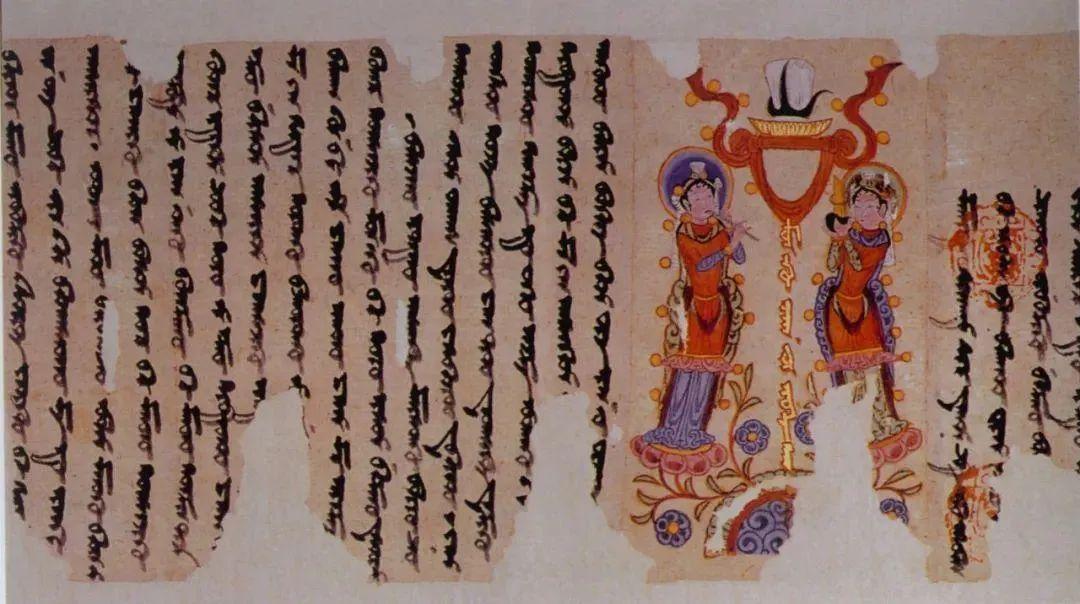
Manichean Documents in Cornish Language Unearthed in Berziklik
A large number of documents in Suttese have been unearthed along the Silk Road, confirming the widespread use of the Suttese language in the Central Plains, the Western Regions, the Northern Desert, Central Asia and other regions. Most of the known documents, except for the 4th century Cornish letters found in Dunhuang, are relics of the 6th to 11th centuries, mostly paper codices, but also some wooden documents and parchment books. Among them, the longest one is the Sutra on the Birth of Prince Sudaraja, and there are also the Sutra on the Heart of Prajna Paramita, the Golden Light Sutra, the Mahaparinirvana Sutra, the Great Compassion Sutra, the Zen Sutra, the Sutra on the Causes and Effects of Good and Evil, the Sutra on the Prajna Sutra, and the Sutra on the Questions Asked by the Long-clawed Brahmans, etc. These sutras were almost all translated from the Chinese. Almost all of these sutras were translated from Chinese. In addition, there are Manichaean classics written in the Cornish language, mainly the Book of Giants, the Book of Gospels, and the Book of Nations. The number of Nestorian classics written in the Cornish language is small, mainly translated from the ancient Syriac classics, mainly the remnants of the New Testament.
The discovery of these documents and artifacts shows that Suttish civilization spread widely and had far-reaching influence among the peoples along the Silk Road in the Middle Ages. The activities and culture of the Cornish people played an important role in the cultural exchanges between China and the West.
Third, the creation of Cornish alphabet and migratory bird language
The Sut script was widely spread among the Turkic people. Since the second half of the 6th century, the Eastern Turkic people began to use the Sutra alphabet to record the Turkic language. [8] From the creation of the Turkic Khanate, the Sultanate alphabet provided the Turks with a very convenient cursive script. The first monarch of the Western Turkic Khanate, Murodimi, presented a letter written in Scythian characters to Justinian II of Byzantium, who had it translated by the Byzantine Emperor, and the Scythian characters in this case refer to the Cornish script. [10] This suggests that over the course of centuries, Turkic languages were written in the Cornish script, and that the Cornish script was used in the writing of the Turkic languages. [10] This suggests that for centuries, Cornish was the international lingua franca of Central Asia.
From the Turpan excavated documents, as late as the end of the 5th century, its script has been for the Turkic and migratory migratory peoples to recognize and use. 1975, in Turpan tombs found nine “generation of people” wooden plate. On the front of the book in Chinese “代人”, the back of the text for the Cornucopia, of which can be interpreted three, one spelled Turkic - migratory language kiši (meaning people), the other two spelled in Chinese, a rin “people”, a tairin “people”, a tairin “people”, a tairin “people”, a tairin “people”, a tairin “people”, a tairin “people”, and so on. The other two are spelled in Chinese, one as rin “person” and the other as tairin “generation of people”. [11] Judging from the surviving 8th-century coins of the Turkic tribes, which were mainly inhabited in the Seven Rivers Valley, the Turkic language was spelled in the Cornish alphabet in those days.
The era of migratory bird Khanate in the north of the desert, the Cornish language in the north of the desert has been more widely used, the famous migratory bird monument “nine migratory bird Khan monument” and “Seville monument” are used Cornish language. Nine migratory falcon khan stele” in 820, written in Turkic Luni, Chinese and Cornish, recounting the migratory migratory Mouyu Khan in 763 to give up the shamanism in favor of Manichaeism in detail. The Chinese portion of the tablet is relatively well preserved, while the Suttese portion is very poorly preserved, but it is possible to decipher some of the lines, such as: “[In place of] the religion of burning fire, [he] accepted the religion of the sacred Mār Mān ...... In the place called Xartak, [he] burned all the idols to the ground. In the place called Xartak, [he] burned all the idols to the ground. ......[12] These phrases are easily connected with the Chinese part of the stele, which reads, “There should be carved demonic shapes, and all of them should be burned with heat to pray to the gods and worship the ghosts, and rejected and subjected to the religion of the Ming Dynasty”[13] and so on. From this point of view, “nine surnames of migratory birds Khan stele” of the Chinese, Turkic and Cornucopian content should be corresponding to each other, enough to show that the migratory birds to the Cornucopian knowledge and love is from a long time.
The migratory birds have always been known for their good compatibility with foreign civilizations, they believed in Shamanism, Buddhism, Manichaeism, Nestorianism, Zoroastrianism, Taoism and Islam, etc., of which Manichaeism, Nestorianism, Zoroastrianism in the migratory birds are related to the Sultan. 6 ~ 9 centuries, the Sultan's language and writing almost became one of the common communication tools on the Silk Road, and according to the historical records, migratory birds rely on the Sultan to engage in business and trade. The New Tang Book - migratory birds biography recorded: “the beginning of the Huihe to China, often participate in the nine surnames of Hu, often stay in the capital, up to a thousand people, live in the capital of the property is very thick”. [14] In addition, there are some of the name of migratory birds “nine surnames Hu”. Ziji Tongjian” volume 2.25 dali fourteen years (779) July gengchen article: ”imperial edict of Huihe all Hu in the capital, each serving their clothes, no effect on the Chinese. First of all, Huihe stayed in the capital division of often thousands of people, the business Hu pseudo-services and mixed living and doubled, the county officials day to give breakfast rations.” [15] These nine surnamed Hu were both Manichaean monks and merchants, participating in the politics of the Huihe Khanate through missionary activities on the one hand, and relying on the political power of Huihe to make huge profits on the other. It was due to the economic factors, coupled with the Manichaeism practiced by the Cornish people became the state religion of the migratory birds, the migratory birds had to learn and use the Cornish language. [16] After helping the Tang to quell the rebellion, the migratory birds entered into an agreement with the Tang to exchange horses for silk and silk, and it was mainly the Sut people who helped the migratory birds in their economic exchanges with the Tang.
In 763, Mouyu Khan made Manichaeism the state religion of the migratory birds in the north of the desert,[17] and the use of the script gradually replaced the Turkic language with the Suttese and Manichaean languages. This can be fully illustrated by the large number of documents in Suttese and Manichaean languages obtained by the “expeditions” of various countries in Dunhuang and Xinjiang at the end of the last century and the beginning of this century. Early for the spelling of the migratory bird language of migratory bird alphabet and cornucopia of letters there is no difference, due to the original cornucopia of letters can not faithfully reflect and record the migratory bird language, the gap between them is very obvious, to the user to bring great inconvenience. Therefore, it was necessary to reform the script itself by adding one or two dots on the left or right side of the letters to distinguish the migratory language from the Suttese alphabet, thus creating the migratory language on the basis of the Suttese alphabet. [18]
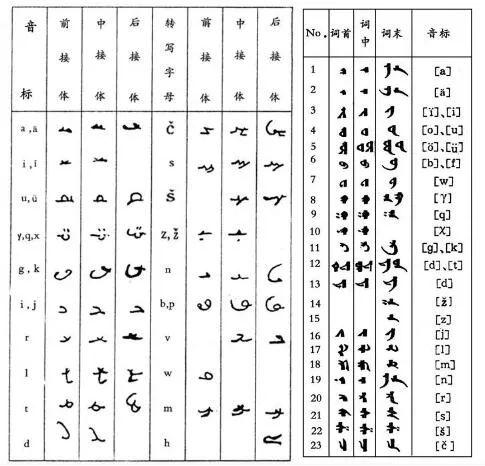
Cornucopia and migratory bird script comparison
The migratory bird script has had a great impact on history, and was once one of the scripts used in the Hexi Corridor, the Western Regions, and Central Asia during the Song and Yuan Dynasties, and has been widely used to write edicts, religious texts, literary works, contracts, and calendars, etc. It was also adopted by the Mongols to create their own script, migratory bird Mongolian, which has been in use up to the present day and has indirectly influenced the creation of Manchu and Sibeo scripts. This script indirectly influenced the creation of the Manchu and Sibe languages. [19]
The Continuing Influence of the Cornish Alphabet on Later Generations
The Sut people declined in the Tang Dynasty, especially after the 10th century, but the Sut language script did not die out, but was used for a long time. Ancient writings unearthed at Dunhuang show that the language was still spoken during the Quyijun period (9th-10th centuries), especially by migratory Sutis.[20] Ancient writings found at Dunhuang show that the language was still spoken during the Quyijun period (9th-10th centuries), especially by migratory Sutis. [20] The Suṭe language texts found at Dunhuang consist mainly of Buddhist scriptures, in addition to accounting documents, letters, and miscellaneous writings.[21] Zhang Jinshan (Cā Kimä-śani), an emissary from Ü-Tsang who traveled to Shazhou on a mission in 982, wrote the Burning Lamp text and the Vow of Fulfillment in Chinese and Ü-Tsang, respectively, and signed them in Suṭe language texts at the same time.[22] Zhang also inscribed his own name, in the Ü-Tsang language, on the title of the Tales of Buddha's Birth in the Ü-Tsang language (Ch. 00274), using Suṭe letters.[23] Zhang also used Suṭe letters in the title of the Tales of Buddha's Birth ( Ch. 00274) and in the margins of The Essence of Healing (Ch. ii. 002). [22] This fact indicates that the Suttese language text was still in use to some extent during this period. The Suet language disappeared around the 11th century, but its presence can still be seen in the subsequent Buddhist classics in the Huifeng language. For example, T M257a, a written copy of the Dharma Flower Sutra in migratory language unearthed in Turpan, is a relatively special written copy. First of all, it uses the “Sutra script”, and secondly, the content of the translation is unique, probably based on or referring to versions other than the surviving Chinese and Sanskrit texts.[23] In addition, the translation is still found in the German language. [In addition, in the collection of the Oriental Department of the German National Library, there is another migratory text, No. Mainz 225, which is written in migratory Cornish script, and its content should be from the translation of the Dharma Flower Sutra, but the scroll is too tattered and difficult to be read. Combining various factors, it can be assumed that the above translation of the Dharma Flower Sutra was probably made with reference to or on the basis of the Cornish text. This is supported by linguistic evidence. For example, the word up(u)di (lotus), which appears in lines 10 and 17 of this document, is derived from the cornish text wpδy (Sanskrit uppala). In the Cornish language, δ is the equivalent of the Sanskrit l. In other migratory texts, the transliteration of the Chinese word for “lotus” is generally adopted directly, with the use of utpal in only one place; and S(a)mantib(attr) (普贤) in the 11th line of the document is generally written as Samantabadira (Samantabadira), where it is written as Samantabadira, where i is a typical phenomenon in Suttese; the word-final -tt- is also common in Suttese texts. All these suggest that the document was probably translated from or referenced to a now-defunct Sut language text, or that the translator of the migratory text was a Sut. [24]
The migratory language, which was based on the Sut language, later became the basis for the creation of the migratory Mongolian language. The Mongols first emerged in the northern steppe of the desert and had no written language. With the unification of the Mongolian ministries, the growing power and geographical expansion, and the strengthening of ties with neighboring ethnic groups, the creation of writing and the need to use the script is increasingly on the agenda, it is in this context, migratory birds quietly stepped into the Mongolian court. 1204, Genghis Khan captured the migratory birds of the Tata Tonga, and ordered him to use migratory birds of the Mongolian script as the basis for the creation of Mongolian language as a national character, which is the so-called migratory birds of the Mongolian language, also known as the old Mongolian. The Yuan History, Volume 124, “Tata Tong'a Biography”, reads: “Tata Tong'a, a fear of Wooden people. Sexual intelligence, good speech, well versed in the country's text ...... emperor good, ordered to live in the left and right. Is after all the system will, began to use the seal, is still ordered to hold it. The emperor said: 'You know your own text? Tata Tong A悉以所蕴对,称旨,so ordered to teach the crown prince of the kings to fear the Woods character book state language.” [25] Zhao Gong Meng Tartar Record also contains: “its customs are simple, then there are migratory birds as neighbors, every two (when the West is wrong) river wrestling, trafficked in its country. To date, the documents used in other countries, all with migratory bird characters, such as the Chinese flute score characters.” [26] Here the so-called ‘migratory bird’ is used to refer to the ‘migratory bird’. [26] Here the so-called “dread wood character”, “migratory character” that is, the migratory language. The name “migratory bird language” when the beginning of this.
The Mongolian language was spelled with migratory bird script, and this special combination was later called migratory bird Mongolian script. In the 17th century, the Mongolian language changed a lot, and the original migratory Mongolian script often could not accurately express all the sounds of the Mongolian language, which brought a lot of inconvenience to the phonetic records, and made the translation of Buddhist scriptures more difficult. The translation of Buddhist scriptures was beset with obstacles. According to this situation, Zayaban Zhida was modified on the basis of the original script to make it able to write Mongolian more clearly, “Todorkhai Mongol” was born. “Tote” is the phonetic translation of Mongolian, meaning ‘clear’, Tote that is ‘clear writing’. Foreign scholars also call it Kalmack. This script continues to be used in the Weilat Mongols of Xinjiang, and is also known as the “Weilat Mongolian script”. [27]
In 1599, Manchu ruler Nurhachu ordered Erdeni and Kagai to create a Manchu script based on the Mongolian alphabet, known as “Old Manchu” or “Uncircumcised Manchu”, and in 1632 Huang taiji ordered the transformation of the Manchu script to include 10 specific alphabets, with the addition of circles on top of Old Manchu. Added 10 specific letters, consisting of 131 syllables of the new writing system, known as “new Manchu”, has been used for hundreds of years. The use of Manchu directly contributed to the formation of the Sibe script.
Xibo in the annexation of the Qing Dynasty began to use the Manchu language. 1947, Yining “Xisuo cultural associations,” the main members of the original use of Manchu for the appropriate increase or decrease in the original 131 syllables in the 13 syllables abolished, and another 3 new syllables Symbol, made of the Xibo language, used to this day.
The migratory birds also had a certain influence on the formation of the Khitan script. Li Dinghuang according to the Khitan word mourning book used in the chronological method with the consistency of the migratory calendar, as well as migratory birds and Khitan language grammatical features of the similarity, that the Khitan small characters “and the ancient migratory birds closely related to the language. [28] More researchers believe that the Khitan Xiaozi adopted the Chinese characterization method, and at the same time referred to the pinyin method of the migratory birds, and the two combinations were combined to form words. [29] In short, the production of Khitan characters is not unrelated to the migratory languages. [30]
To summarize, the Cornish language had a direct or indirect influence on the writing of many ethnic groups along the Silk Road. The migratory bird language was created based on the Cornish language, which in turn led to the formation of the migratory bird Mongolian language, which in turn directly influenced the creation of the Manchu language, which later directly evolved into the Xibeowen language. The creation of the Khitan language was also linked to the migratory language. [31] The influence of the Cornish language on the creation of these scripts is illustrated below:
Cornish -> migratory bird script -> migratory Mongolian script -> Manchu script -> Sibeo script
Chetanese
Between the 3rd and 8th centuries, some of the Kurds left their homes and began a wave of migration and trade to the East, entering the Central Plains along the Silk Road, and their activities had a significant impact on the political, economic, and cultural spheres of the Han and Tang dynasties.At the end of the 8th century, the Arabs took over the Kurds' homeland, and the Kurds who stayed in Central Asia proper were gradually arabized, while the Kurds who entered China were gradually sinicized. The Sultanate was gradually Sinicized. The Suit language, which had been in use since the 2nd century, gradually declined from the 10th century and almost disappeared in the 11th century, but its influence still exists today, and can be seen vaguely in Mongolian and Sibean documents.
Notes:
[1] Chen Haitao and Liu Huiqin, A People from the Crossroads of Civilization: A Study of the Sutis Entering China in the Tang Dynasty, Beijing: Commercial Press, 2006, p. 113.
[2] Zhu Lei, “The ‘Price of Claims’ of the Qu's Gaochang Kingdom,” Wei Jin Nan Bei Chao Sui Tang Shi Biao (Materials on the History of Wei Jin Nan Bei Chao Sui and Tang dynasties), No. 4, 1982, pp. 17-24.
[3] Rong Xinjiang, “Persia and China: The Intermingling of Two Cultures in the Tang Dynasty,” Chinese Academic, No. 4, 2002, pp. 61-64.
[4] Rong Xinjiang, “Ancient Cornish Migration around the Tarim Basin,” West Region Studies, 1993, No. 2, pp. 8-15; Rong Xinjiang, “The Migration of Cornish People and Their Settlements in the Northern Dynasties, Sui and Tang Dynasties,” Studies in Chinese Studies, Vol. 6, Peking University Press, 1999, pp. 27-85.
[5] Ikeda Wen, “おける敦煌のソグド人聚落” (The settlement of the Sogdians at Dunhuang in the middle of the 8th century), ユ-ラシア Cultural Studies, No. 1, 1965, pp. 49-92; Chen Haitao, A People from the Crossroads of Civilization: The Sogdians who Entered China in Tang Dynasty Research, Beijing: Commercial Press, 2006, pp. 113-125.
[6] Cheng Yue, “Commercial and Political Activities of the Cornuits Entering China in the Tang Dynasty,” Northwest Ethnic Studies, No. 1, 1994, p. 61.
[7] F. Grenet-Nicholas Sims-Williams, The historical context of the Sogdian Ancient Letters, Transition periods in Iranian history, Actes du Symposium de Fribourg-en-Brisgau (22-24 Mai 1985), Leuven 1987, pp. 101-102; Nicholas Sims-Williams, The Sogdian merchants in China and India, A. Cadonna & L. Lancelot, “The Sogdian Ancient Letters,” The Sogdian Ancient Letters in China and India. Cadonna & L. Lanciotti (eds.), Cina e Iran da Alessandro Mangno alla dinastia Tang, Firenze, 1996, pp. 46-51; Nicholas Sims-Williams, translated by Emma WU translation: “粟特文古信札的新刊本的进展”, “粟特人在中国-历史、考古、语言的新探索”(《法国汉学》第10号辑), Beijing: Zhonghua Shuju, 2005, pp. 72-87.
[8] Louis Bazin, Turcs et Sogdiens: Les enseignements de l'inscription de Bugut (Mongolie), Mélanges linguistiques offerts à Émile Benveniste, Paris, 1975, pp. 37-45.
[9] Louis Bazin, Turcs et Sogdiens: Les enseignements de l'inscription de Bugut (Mongolie), Mélanges linguistiques offerts à Émile Benveniste, Paris, 1975, p. 45.
[10] É. Chavannes, Documents sur les Tou-Kiue Turcs Occidentaux, Paris, 190, pp. 234-235.
[11] Kurban Wai Li, “Ancient Turkic Wooden Plaque from the Fifth Century A.D. Unearthed in Turpan”, Cultural Relics, 1981, No. 1, pp. 63-64.
[12] Takao Moriyasu, Toyo Yoshida, and Akio Katayama, “カラニバルガスン碑文”, Takao Moriyasu and オチル, eds. “モンゴル国现存遗迹-碑文調查研究报告” (A Report on the Investigation of the Existing Ruins and Inscriptions of the Monumental Kingdom), Central Society of ユーラシァ学研究會, 1999, pp. 215~216.
[13] Hada Hen, “唐代回鹘史の研究” (Studies on the history of migratory birds in the Tang dynasty), Dr. Hada's Historical Papers, vol. 1, History, Kyoto: Tongbonshe, 1975, p. 307; Cheng Shuluo, “”“释漢文〈九姓回鹘毗伽可汗碑” (Interpreting Chinese text on the relationship between migratory birds and the Tang dynasty in the tablet of the Nine-name migratory bird Vijay Kohan), Journal of the Central Academy of Ethnic Studies (中央民族学院学报), no. 2, 1978, p. 21; Lin Meicun, Chen Ling, and Wang Haicheng, “Nine-name migratory bird Khan Stele Study”, Yu Taishan, ed. Eurasian Journal, No. 1, Beijing: China Bookstore, 1999, pp. 160-161.
[14] Xin Tang Shu (The New Book of Tang), Volume II.177, “Hui migratory birds”, Beijing: Zhonghua Shubu, 1975, p. 6121.
[15] Ziji Tongjian, Volume II.25, Beijing: Zhonghua Shubu, 1963, p. 7265.
[16] Yang Fuxue and Niu Ruji, “Mouyu Khan and Manichaeism,” Dunhuangxue Serials, No. 2, 1987, pp. 86-93.
[17] Yang Fuxue, “Re-exploration of the Problem of Reforming Manichaeism in Huifeng”, Wen Shi, No. 1, 2013, pp. 197~230.
[18] Niu Ruji, “Examination of the Reasons for the Historical Evolution of the Uyghur Script”, Journal of Xinjiang University, No. 1, 1990, pp. 113~116; Geng Shimin, “Introduction to Dunhuang Turkic and Hồng Fúghún Documents”, Taipei: Xinwenfeng Publishing Co. 1994, pp. 91~100; Yang Fúkuei, “On the Lineage of Multiple Scripts in Ancient Uyghur”, Research on the History of Ethnicity, No. 5 Series, Beijing: Minzu Publishing House, 2004, pp. 288~315.
[19] Geng Shimin, An Introduction to the Dunhuang Turkic-Huifeng Documents, Taipei: Xinwenfeng Publishing Company, 1994, pp. 91-100; Yang Fuxue, Huifeng Literature and Huifeng Culture, Beijing: Minzu Publishing House, 2003, pp. 125-126.
[20] N. Sims-Williams - J. Hamilton, Documents turco-sogdiens du IX-X siècle de Touen-houang, London, 1990, pp. 9-10.
[21] H. W. Bailey, Khotanese Texts, I, Cambridge 1969, pp. 198-219, 104; H. W. Bailey, The Colophon of the Jātaka-stava, Journal of the Greater India Society, XI. 1, 1944, pp. 10-12; Takata Tokio, Multilingualism in Tun-huang, Acta Asiatica 78 (Tun-Huang and Turfan Studies), Tokyo 2000, pp. 51-52.
[22] Takata Tokio, Multilingualism in Tun-huang, Acta Asiatica 78 (Tun-huang and Turfan Studies), Tokyo 2000, p. 52, n. 5.
[23] D. Maue und K. Röhrborn, Zur Alttürkischen Version des Saddharmapundarīka-Sūtra, Central Asiatic Journal, XXLV, no. 3/4, 1980, S. 258-260.
[24] Yang Fuxue, “The Fahua Sutra and Its Value in Huifeng Text,” Huang Xinchuan, ed. Gwangsan jingju temple and Tiantai Sect Studies, Zhengzhou: Henan People's Publishing House, 2015, p. 127.
[25] [Yuan Shi], vol. 124, Tata Tong'a Biography, Beijing: Zhonghua Shubu, 1976, p. 3048.
[26] [Song] Meng Gong, Meng Tartar Preparatory Record - State Number and Year, Wang Guowei, Meng Tartar Preparatory Record of Black Tartar Matters, Beiping: Wendengge Shusha, 1936, p. 13.
[27] Yang Fuxue, The Documents and Culture of the Hui Fen (回鹘文献与回鹘文化), Beijing: Minzu Publishing House (民族出版社), 2003, pp. 134-135.
[28] Li Dinghuang: “A Comparative Study of the Khitan Script with a Trial of the Ancient Huifeng Script”, Journal of Sun Yat-sen University, 1957, No. 2, pp. 174~177.
[29] Yamaji Hiroaki, “契丹制字の研究” (Study of the Khitan character system), Tokyo, 1956; Institute of Nationalities, Chinese Academy of Social Sciences, and the Khitan Character Research Group of the Mongolian Language Research Office of the University of Inner Mongolia, “On the Study of Khitan Small Characters” (About the Study of Khitan Small Characters), Journal of the University of Inner Mongolia, 1977, No. 4, pp. 1-97.
[30] Yang Fuxue, “The Influence of Uighur Language on the Kitan”, Ethnic Languages, No. 1, 2005, pp. 61-64; Daniel Kane, Uighur Influence on the Creation of the Kitan Script--Conflicting Evidence from the Liao History and the Kitan Inscriptions, paper presented at the International Symposium on Cultural Studies of Ancient Huifeng Archaeology (Ulaanbaatar, August 1-5, 2009)
[31] Yang Fuxue, The Literature and Culture of migratory birds, Beijing: Nationalities Publishing House, 2003, pp. 125-126.