

Han Dynasty Post on the Silk Road
As early as the Yin and Shang dynasties, in order to satisfy the operation of the huge state apparatus, the construction of roads leading from the royal capital to all parts of the country and the organizations responsible for transmitting official documents and receiving officials and messengers along the way began, which was the post system consisting of post roads and post stations. The postal routes of the central dynasty in the west were the eastern part of what was later called the Silk Road. The postal institutions and the thousands of miles of postal routes represented by Hangquanzhi constitute the postal system in Gansu that connects the east and west, and provides the life and transportation guarantee for the smooth flow of the eastern part of the Silk Road. The Han Jian unearthed in Hangquanzhi reveals the actual situation of political, economic and cultural exchanges between the two Han Dynasty and the West, and it is a historical record and an important symbol of the prosperity of the Silk Road in the two Han Dynasty.
I
Stretching across the Eurasian continent of the silk road, the basic direction of the formation of the Han dynasty. Academics usually the Silk Road in Xinjiang is known as the Silk Road in the middle, the western end of the Hexi Corridor to the east until the dynasty capital of Chang'an, Luoyang between the line known as the Silk Road East. The two thousand kilometers of postal routes in present-day Gansu are the most important part of the Eastern Silk Road.
The Han Jian unearthed at Juyan and Hangquan in Gansu reveals the setting up of postal routes and postal stations from Chang'an City of the Han Dynasty to the Hexi region. The new Jane of Juyan records the mileage of postal routes from Guanzhong along the Jingshui River to Longxi and then to the Hexi Corridor during the Xinmang period, with a total of four groups of Jane texts. It introduces the mileage of the post route from Chang'an to Gaoping (present-day Guyuan, Ningxia) via Pingliang, Gansu, the mileage of the post route from Old Woman (present-day Luyang Town, Jingtai County) across the Yellow River to Guzang (present-day Liangzhou District, Wuwei City), and the mileage of the post route from Wuwei County to Zhangye County and the situation of post placement. Dunhuang Hangquanjian records three groups of textual janitories on the Hexi post road.
It describes the mileage and posting of the post route from Cangsong (present-day Anyuan Town, Zhu County) to Xianmei (present-day Fengleibao, Liangzhou District), from Chi (present-day Liangjiadun Village, Ganzhou District) to Miaoyu (present-day Camel City Ruins, Gaotai County), and from Yumen (present-day Chijin Town, Yumen City) to Yuanquan (present-day Sidougou, Guazhou County), respectively. From Yuanquan to the west, out of the Yumen Pass or Yangguan, into the middle of the Silk Road, and then to Central Asia, West Asia, can be as far as the Mediterranean coast of the Roman Empire.
These documents, described from Chang'an to the west, over the Longshan Mountains, across the Yellow River, along the Hexi Corridor by Wuwei, Zhangye, Jiuquan up to Dunhuang dozens of post and the mileage of each section of the stagecoach road, proving to us that two thousand years ago, the eastern Silk Road stagecoach road is true.
Two
To protect the security of the Silk Road is mainly along the eastern route of the Great Wall on the north side, beacon flints, pavilions, military barriers, such as military systems and the western counties lieutenants, county lieutenants, townships, such as magistrates. And to ensure the smooth flow of the Silk Road, responsible for the transmission of official documents, materials transfer, personnel transportation, food and lodging, is the state set up the post system.
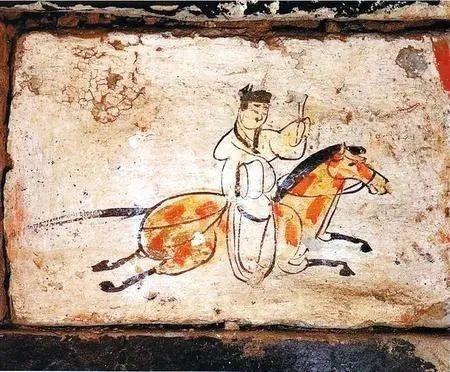
▲Painted Postman's Brick Unearthed in Jiayuguan Pass
Post, also known as post, passing post, is in the land and water transportation lines, every certain distance to repair a pavilion, the pavilion has guest rooms, food and travel cars, horses, boats, as well as specialized staff, both the modern military system, military station and the local government hospitality, as well as postal and machine communication station functions.
Gansu region in the Han Dynasty, military and political affairs, and in the Silk Road, the eastern section of the transportation corridor, the post is more busy. By the Western countries to Han's princes, ambassadors or trade personnel, at all levels of the Western region and official travelers, in the pavilion in the room and board, to the pavilion in the carriage to the next post. The official letters and reports of the government and the army were sent by the post stations to be transmitted one by one along the post road. When Huo Zai Deng accepted the surrender of the Hun King of Xiong Nu, he made use of the postal system to send the Hun King of Xiong Nu to visit Emperor Wu of the Han Dynasty in the first place.
In the Western Han Dynasty, the general manager of the postal system was the Dianzhongguo (later renamed the Dahonglu), and the postal system was supervised by the ministers of the various counties and states. Post by the post minister in charge, under the barn, kitchen, stables, set up four Scrooge, Zuo for the officials, there are pass House Scrooge, post book, post people, etc., there are several horses or dozens of horses. In Gansu and other places, responsible for the transmission of documents, the postman for the garrison. From the Western Han Dynasty, it can be seen that the sparsely populated Gansu region, the spacing of the post, roughly in the 50 to 90 Hanli, or between 20.8 km and 37.4 km.
The site of Hangquanzhi in Dunhuang County during the Han Dynasty is the largest and best-preserved ancient postal reception organization ever discovered, and it was the first post on the eastern section of the Silk Road from the Western Regions to the Central Plains. Hangquanzhi excavated from the Western Han Dynasty Emperor Wu Di Yuan Ding six years (111 years ago) to the Eastern Han Dynasty Emperor An Di Yongchuyuan year (107 years ago) of more than 23,000 pieces of lettered documents, silk, paper books and various relics of tens of thousands of pieces. These documents have a large number of various books involving the functions of the post, a more complete reflection of the functions and utility of the post in the Han Dynasty. According to the textual analysis of the documents, there were 37 or 47 officials, 40 horses, 6 to 15 carts, and when necessary, they would requisition private carts and horses for transferring people or materials.
Han Dynasty writing materials are mainly bamboo bamboo wooden documents, each piece of mail book surface are labeled with the recipient, delivery mode, sealing category, transmission handover content of the cover - seal inspection title agency, tied with a rope to seal the seal after the clay seal. The way of postal book transmission, there are postal line, to the next line, to the pavilion line, the line and light foot line and so on. Among them, Chih Hsing was the fast transmission of urgent documents of the border counties by carts and horses. Through the Hangquan set by the transmission of mail is often very important, such as Hangquan a Jane recorded mail “two letters: one of the Changluo Hou, a Princess of Wusun”, is in the Western Regions of the Changluo Hou Changhui and married to the King of Wusun (now Kyrgyz) Princess Xiexu to the court's letter.
Hangquan a brief record of “a letter out of the West, the court captain chapter. Go to the West riding lieutenant. In the second month of the ezi day under the evening meal time by the fish away from the Scrooge, instantly stand on the line.” It was an urgent document sent by the highest criminal law officer of the imperial court, Tingwei, to the Western Region Cavalry Captain. Hangquanzhi received the incoming paperwork in the evening and immediately sent out personnel to deliver it to the west. The postal system of Han Dynasty was strict, and those who did not follow the regulations to miss the deadline and the journey were to be punished according to the law. The efficiency of postal transmission in Han Dynasty was very high. When Emperor Xuan Di of the Western Han Dynasty, Zhao Chongguo sent a letter from Jincheng (now north of Xigu District of Lanzhou) to Chang'an, and then received a return edict from the court, which took only 7 days. In the Eastern Han Dynasty, the three-horseback messenger with the seal of the Emperor could reach 1,000 miles in a day and night.
Han Dynasty from the west to the western region, “the establishment of cantonment in the cream of the field, the list of post in the key road. The orders to go by post were endless in the months and years; the merchants and hu-traders, the daily payment under the plug.” The perfect postal system strengthened the connection between the interior and the frontier and the western region, consolidated national unity, ensured the people's communication and the political, economic and cultural exchanges between China and foreign countries, and promoted the commercial prosperity and urban prosperity.
III
After the opening of the Silk Road, the Han Dynasty “sent envoys to Anshi, Amakai, Lixuan, Jiezhi, and Bianzhu. And the son of heaven is good Wanma, messengers look at each other on the road. All make a generation of foreign countries (batch) hundreds of big, less than a hundred people, people have a present to manipulate big put (imitation) when the Bowang Hou.” The Han Dynasty and the western region of the emissaries, merchants and other people to and from the Gansu area. Suspended spring site and Juyan documents have a large number of Chinese and Western envoys and personnel to and from and reception records.
The Han Dynasty to and from the West: such as hanging spring Jane records “to food to make Dawan Che Cavalry General Chang Shi □”, is to receive a Han Dynasty to Dawan (present-day Turkmenistan) of the military officer. Hangquan Jian “Ganlu two years in April A Yin Shuo Geng Chen ...... sent Hao Zheng Ting Chang Qi Qi He, with the imperial decree to send the punishment I Zhuan”, is to the western region of Tuantian escort relaxation of punishment personnel. Hangquan Jian “□悬泉置度侍少主、长罗侯用吏”. The young master's name is Xiangfu, in the second year of Yuankang (64 years ago), Emperor Xuan of Han decided to marry her to the Prince of Wusun, Yuan Guizhi, and after arriving at Dunhuang, due to the sudden change of the political situation in Wusun, she was recalled to Chang'an, but the Han Jian retains the record of her arrival at Dunhuang.
Hangquan Jian, “The Expense Book of Marquis Changluo,” is a food bill for Changluo Marquis Changhui and his entourage of 154 people and 300 slack-jawed soldiers who were received on a mission to the Wusuns in the fifth year of the Yuankang era (61 years before the Han Dynasty). Hangquan Jian“ ...... music official (boil) order charging dare to say: imperial edict to ride horseback to help pass horse, send broken qiang general, wear canal school captain, messenger Feng lady ......” is Ganlu two years (52 years ago) reception It is the record of receiving the Qiang-breaking general Xin Wuxian and the famous diplomat Feng smartly, the attendant of Princess Xieyou who was married to Wusun Kunmo in the second year of Ganlu (52 years before the Han Dynasty). Reception to the Han Dynasty, Western region of the ruler and ministers and other people. Such as Hangquan Jane “guest Dayuezhi, Dawan, 죄 (Shuo) Le, Ütepe, Dui Le, Jingjie, 扜 弥 king of the emissary eighteen, the nobleman □ people ......”, is the reception of the western region of the Dayuezhi (now Central Asia, Amu Darya basin) and other emissaries of the seven countries. Juyan Xinjian “Shenjue two years eleven diamao Shuo yichou ...... □□□□ sends the king of Riyu ride to Heian ......”, the king of Riyu is the king of the Xiongnu in the western region.
When the western region guards killed the king of Loulan, its head is also through Dunhuang transferred to Chang'an, Juyanjian “edict Yiru candidate Zhang hair pawns said: hold the head of the king of Loulan to go to Dunhuang, stay ten pawns, female interpreters two, stay to defend the certificate”. Western countries to Han personnel return trip, the Han Dynasty appointed a considerable rank of officials courtesy of its exit, many are collective transfer. Such as Hangquan Jane “Wufeng four years (54 years ago) June c c, so that the host and guest scattered riding Guanglu Daifu Tian Fu Wei system imperial edict Royal Historian said: so that the Yunzhong Taishou Anguo, the former □ Weiyang Canglong □ Weishi horse Su □ Wujiang, so that to send Cheshi Wang, the Wusun country guests, and the military waiter Zhou Chongguo Zaixian club, for the driving two light carriage, two people carried... ...”, the two-thousand-stone governor of Yunzhong accompanied the honorable king of Cheshi back to his country. Hangquanjian “this messenger Wangjun will Ütepe king following thousand seventy-four people, May cixu hair Lufu, degree of use geng Yin to Yuanquan.” This batch of return including the king of Ü-Tsang, including a total of 1074 guests in the Western Region. Dunhuang Border Jane “know what country Hu a man, take Pavilion East □”, is a record of the entry of a Westerner.
Four
The Han Dynasty developed the commodity economy, “rich merchants and merchants flow around the world, trading in all things, get what they want”. The Han Dynasty through the Silk Road frequently to silk and BMW-based trade between China and foreign countries. Western countries generally in the name of envoys to contribute to the Han Dynasty, the court routinely give them a higher value of silk and other items of reward, which in fact is a form of Sino-foreign trade. After the entry of ambassadors and merchants from the Western Regions, the “tributes” they carried were generally purchased by the border counties, and the Hangquanjian: “The money of 22,350 was offered to the guests of the Wusun country to offer a strike,” is a record of the Dunhuang County's offer to purchase the goods contributed by the guests of the Wusun country.
The “Western Jahu, to a place always stop”, after getting the money, in the places along the route to buy the required items, or transported to other places or transported to the Western Region to sell for profit. Han Dynasty to the West often carry a large number of silk and other items, rewarded to the Western region of the ruler and ministers. Through the Silk Road, many treasures from the Western Regions spread to Gansu and the interior. Emperor Wu of the Han Dynasty “heard that Tianma and Putao were connected to Dawan and Anshi. Since then, pearl, armor, rhinoceros, Cui Yu of the precious surplus in the harem, Puzui, Longwen, fish eyes, sweat blood of the horse in the yellow door, the huge elephant, the division of the son, the fierce dog, the big bird of the group of food in the outside of the confines. The different sides of the foreign objects, the four sides and to”. Western grapes, alfalfa, fava beans, etc. have been transmitted to Gansu, Hangquan Jane: “out of the money twenty Zuo Guangqing book Dunhuang buy alfalfa food horse”, indicating that a large number of alfalfa planted in Heshi, so you can trade at any time.
History books say: “grapes ...... born Longxi, Wuyuan, Dunhuang valley.” Juyanjian: “Hu beans four stones and seven buckets,” indicating that at that time there were many broad beans planted in the Hexi region. There are also hu ma (sesame), hu peach (walnut), hu melon (cucumber), hu coriander (coriander), carrots, etc., allegedly introduced by Zhang Qian from the Western Regions, and they greatly enriched the lives of the inhabitants of all parts of Gansu. Imported from the Western Regions via the Silk Road, there are famous horses, rare animals, fur, jade and so on. Hangquan a brief record of the Han Zhaodi Yuanping first year (74 years ago) in November, the court sent to Dunhuang County to meet the sky horse (blood horse) records. Hangquan Yijian records that the envoys of the kings of Wusun and Shache paid tribute to the camel.
The king of Anshi (present-day Iran) “offered to Han the eggs of the great bird and the Lixuan Good Dazzler”. The Great Bird is an ostrich, and the Dazzler is a magician. “And Han make poor river source, source out of tepid, its mountains more jade, pick to,” Hetian jade so a large number of imported into the river and the interior. Dunhuang, Lanzhou, Wuwei, Jiuquan unearthed glass chess pieces or ear dangles of the Han Dynasty, indicating that the Symposium (now Afghanistan) produced by the Biliu displacement (soda-lime glass) also through the Silk Road to Gansu.
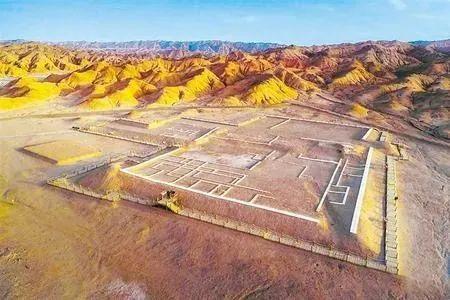
▲Hangquanji Ruins
What the Han Dynasty exported to the western region through the Silk Road was mainly silk and silk fabrics. The western region does not produce silk, the Han dynasty to the western region of the gift or reward items are mainly silk and silk fabrics, the name of the flocculent, silk, embroidery, ïîä, brocade, coir, robes, damask, silk, silk, thick waterproof, silk, drapery, clothing, clothing, clothing, crown and belt and other. Zhang Qian's second mission to the Western Regions, “a gift of gold, coins and silk straight thousands of huge tens of thousands”. Han Emperor Xuan Di Yuan Kang Yuan years (65 years ago), the king of Guzi to the dynasty, Emperor Xuan Di “given to ...... Cherry embroidery miscellaneous silk qi zhen where tens of millions of”. Han Dynasty Hexi has a large number of silk trading, such as hanging spring Jane: “report Zhao Qing before buying Yang Zizhen Tee a horse”, Tee for the red-orange silk fabric.
The Hangquan Jian is a bill from someone in Dunhuang who bought a jacket and brocade from Zhou Xie in Shangdang County in the third year of Emperor Xuandi's Shenjue reign. Dunhuang beacon flint Jane “out of the oxcart transfer silk” language, indicating that the local silk quantity is very large. The merchants from the Western regions who passed through Hexi purchased silk, floss and silk fabrics in the region and transported them back to sell or exchange them for other goods. Swedish sinologist Sven Hedin found a letter in Xinjiang Loulan site, said a local resident bought 4326 large bags of silk, will be used to neighboring countries in exchange for wheat. Gansu in the Han Dynasty in the Silk Road opening, maintenance, economic and cultural exchanges and other aspects of the Silk Road made outstanding contributions, the Silk Road to China and the countries along the route of the political, economic, cultural, artistic, philosophical, scientific and technological and other aspects of the impact is extremely far-reaching.